
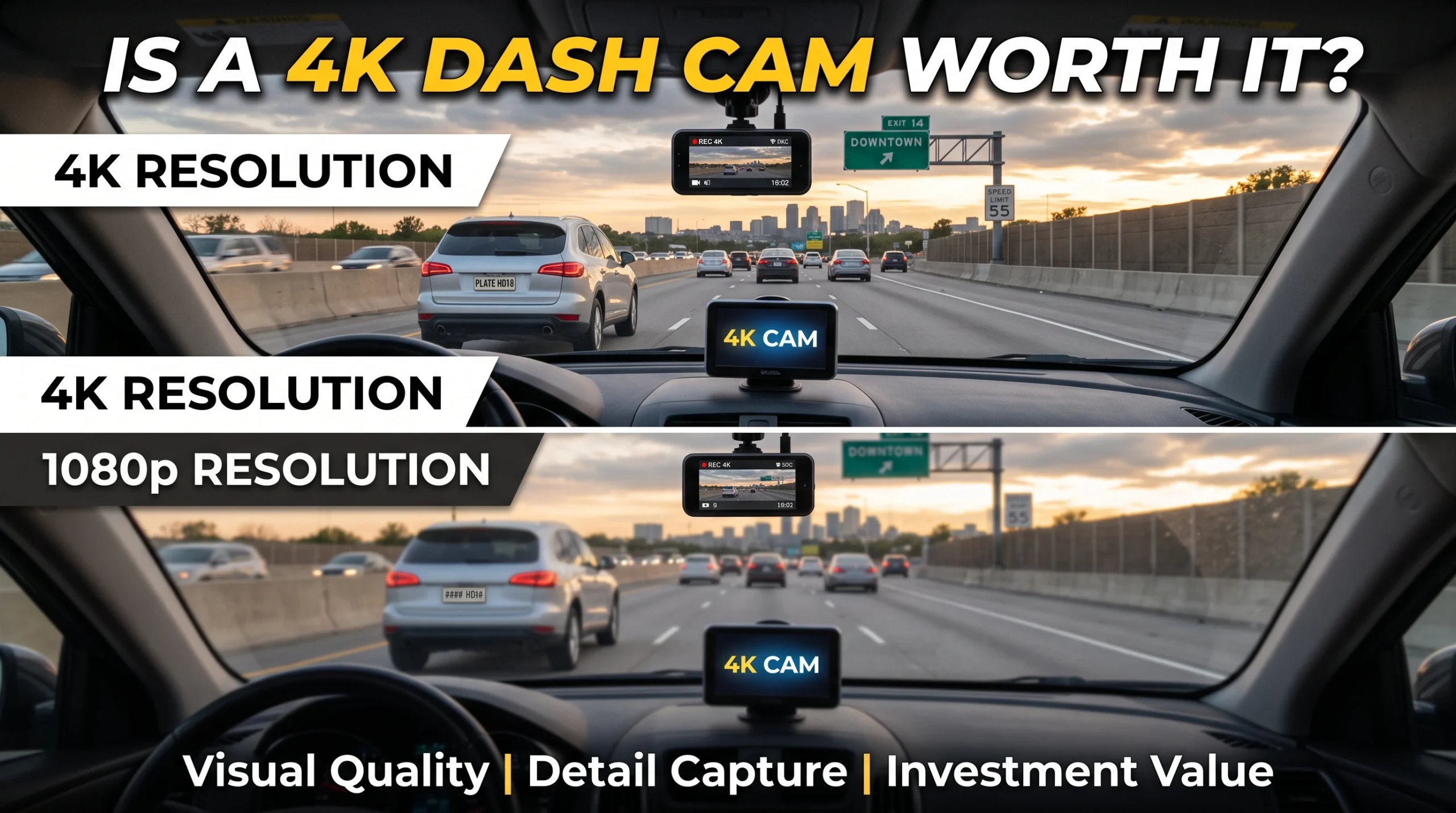
Most people buy resolution hoping for one thing: that the footage will show the number plate of the car that hit them. Resolution contributes to that, but it is one of five variables and not the dominant one. A wide-angle 4K camera can read plates worse than a narrower 2K camera, night performance depends far more on the sensor than on the pixel count, and the extra resolution costs you card space and heat. For many drivers, a very good 2K camera is the better buy.
What actually decides whether a plate is readable
Five things, and resolution is only the first:
- Resolution. How many pixels the sensor records. More is genuinely better, all else equal.
- Field of view. How much of the world those pixels are spread across. A wider view means fewer pixels on any given object, and this trade is direct.
- Sensor and dynamic range. A number plate is a bright retroreflective rectangle on a dark car, often at night, often with headlights in frame. Capturing that without blowing out the plate or losing the car is a dynamic-range problem, not a resolution one.
- Lens quality. Pixels cannot resolve detail the lens did not deliver. A high-resolution sensor behind a mediocre lens produces a large, soft image.
- Distance and relative speed. A plate two car lengths ahead at a standstill and the same plate crossing a junction at speed are entirely different problems, and motion blur is a shutter and processing question rather than a pixel-count one.
All else is never equal, which is why the headline number on the box is a poor predictor of the thing you actually want.
Why a wider camera at the same resolution reads plates worse
This is the trade that gets hidden, and it is worth internalising because it inverts how the specs are marketed.
A camera's pixels are spread across whatever it can see. Widen the view and the same pixels cover more scene, so the number of pixels landing on any individual object, including a number plate, goes down. A very wide camera captures more of what happened and resolves less of it. A narrower camera captures less and resolves more.
Manufacturers advertise both a large resolution and a wide field of view as though they combine into one benefit. They partly cancel. If plate legibility is your priority, a moderate field of view is doing as much work as the resolution, and we go through where the useful range sits in field of view: why wider is not better.
Where the extra resolution genuinely helps
It is not a marketing invention, and there are cases where the top tier earns it:
- Detail at a distance in good light. Daytime, reasonable range, static or slow-moving subject. This is the best case for high resolution and it is real.
- Cropping into footage afterwards. If you need to zoom in on part of the frame, the extra pixels are what let you.
- Wide cameras that need the pixels back. If you want a wide field of view for context, higher resolution partly compensates for the dilution.
- Front channel on a dual-channel setup, where the front does most of the evidential work. The rear channel is often lower-specification anyway, as covered in front-only, dual-channel or three-channel.
What it costs you
Card space, and therefore history. Higher resolution fills a card faster, so the loop overwrites sooner and you retain less. If you sometimes discover an incident days later, that matters.
Heat. More processing means more heat in a device already living in a hot place. This is a real consideration in a warm climate and it interacts with everything in dash cams in extreme heat.
Money spent in the wrong place. The most common upgrade mistake in this category is paying for the top resolution tier on a camera whose power source, sensor or card is the actual limiting factor. The buying order that avoids this is in the dash cam buying guide.
Night performance you did not get. A high-resolution sensor with small pixels can perform worse in low light than a lower-resolution sensor with larger ones. Since a great many incidents happen in poor light, this is not a small caveat, and the sensor claims are worth learning to read, which we do in STARVIS, HDR and night video.
How to decide
- If you drive mostly in daylight and want maximum detail: high resolution is a reasonable priority, paired with a moderate field of view.
- If you drive a lot at night or in poor weather: spend on the sensor and dynamic range first. A better sensor at lower resolution will serve you better.
- If you park outside in a hot climate: favor the camera that runs cooler and has the better power source over the one with the bigger number.
- If you want long retention: lower resolution and a larger high-endurance card keeps more history for the same money.
- If two listings both sound excellent: read them properly. How to read a dash cam spec sheet without being fooled exists for exactly that moment.
FAQ
Is 4K necessary for a dash cam?
No. It helps in good light at distance and it allows cropping into footage. Plate legibility depends at least as much on field of view, sensor quality and lens, and a good 2K camera often outperforms a mediocre 4K one where it matters.
Will a 4K dash cam read number plates at night?
Not necessarily, and not because of the resolution. Night plate capture is a dynamic-range problem, since a retroreflective plate against a dark car with headlights in frame is a hard exposure. Sensor and processing decide this more than pixel count.
Does higher resolution fill the memory card faster?
Yes, meaningfully. That shortens how far back your loop retains footage, which matters if you sometimes need a clip from several days ago.
Is 2K enough for a dash cam?
For most drivers, yes, particularly paired with a moderate field of view and a good sensor. It is a common sweet spot for detail, file size and heat.
Does a 4K dash cam get hotter?
It does more processing, so generally yes. In a hot climate that is worth weighing, since heat is the extreme that does permanent damage to these devices.
AutoGearZone does not sell dash cams and earns no commission from any brand or model named here. More on how we work on our about page.