
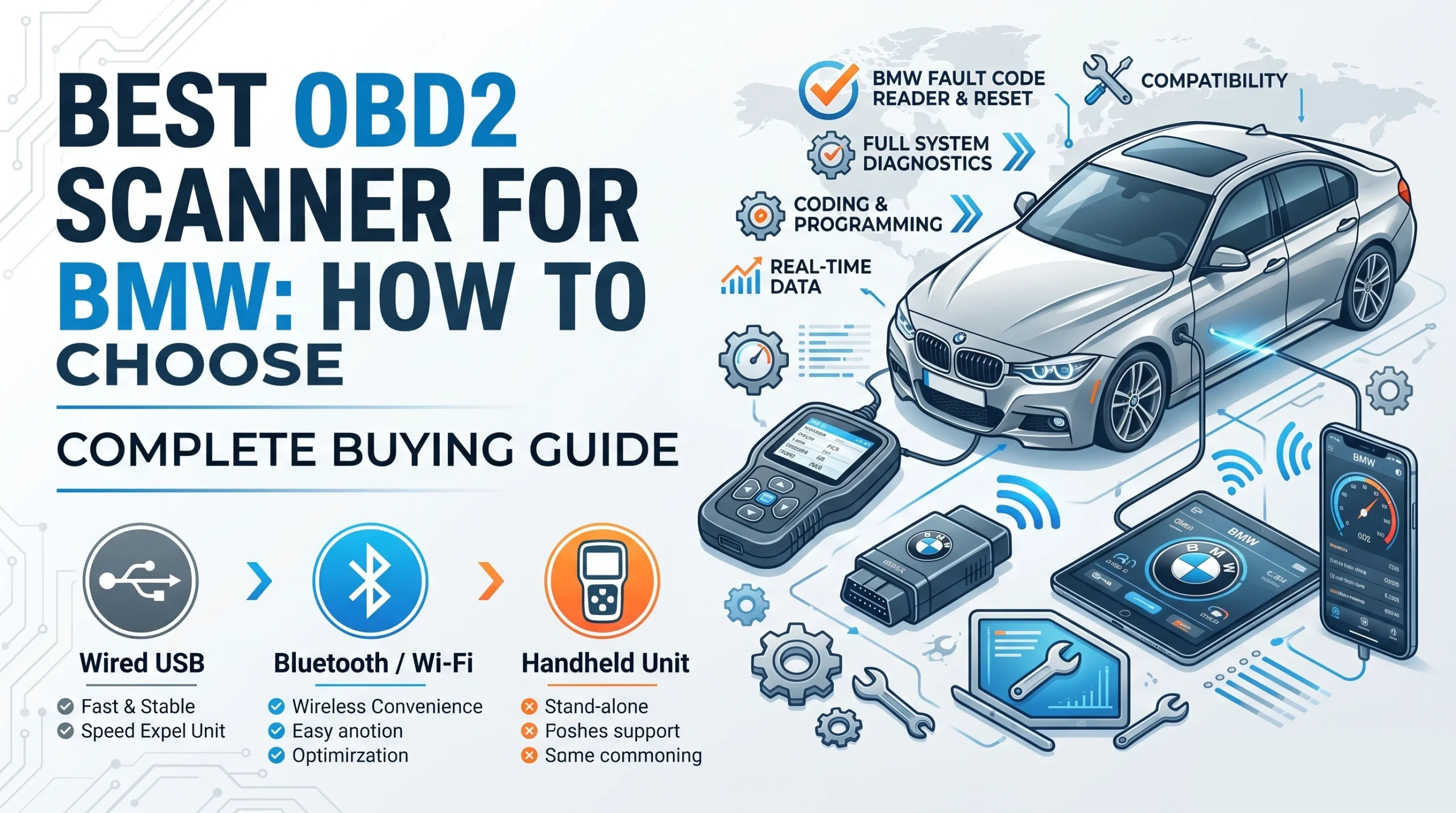
The best OBD2 scanner for a BMW is not the cheapest code reader on the shelf. A basic reader only talks to your BMW's engine and emissions system, so it can turn off a check engine light but stays blind to ABS, airbag, transmission, and the BMW-specific modules where most faults actually live. To get real coverage you want a tool with three things: BMW full-system access (not just generic OBD2), the service functions BMWs need such as oil reset and battery registration, and update support so it keeps reading newer cars. Match that list to the job you actually have, and the right tool becomes obvious.
This is a criteria guide, not a leaderboard. We do not sell scanners and we do not rank a "number one pick," because the correct BMW scanner depends entirely on what you are trying to do. Below we break down each capability, explain what it unlocks on a BMW specifically, and help you match a tool type to your situation.
First, decide what you are actually trying to do
Every buying guide throws a spec sheet at you before asking the one question that decides everything: what job do you have? On a BMW, four jobs need four different levels of tool.
- Just clear a check engine light or read an engine code. Almost any OBD2 reader can do this, including a budget one. If your BMW threw a generic engine fault and you want to see the code, you do not need to spend up. (If the light is on but the car runs fine, that is worth understanding before you clear anything.)
- Read faults across the whole car, not just the engine. ABS, airbag (SRS), transmission (EGS), and body modules each store their own codes. Reaching them needs BMW full-system coverage, which a generic reader does not have.
- Do service work like an oil reset, brake bleed, or battery registration. These are "reset" or "special" functions, separate from just reading codes. BMWs specifically require battery registration after a battery swap.
- Change how the car behaves (coding). Enabling folding mirrors, changing a warning chime, adjusting comfort settings. This is coding, and it is a different capability again.
Figure out which of these you need, then read only the sections that apply. You will save money and avoid buying a professional tool for a job a mid tool handles.
Why a generic OBD2 reader falls short on a BMW
Every car sold in the US since 1996 speaks the standard OBD2 language, so any reader can pull generic engine and emissions codes from a BMW. The catch is that generic OBD2 only defines that emissions slice. It is roughly the engine control module talking about emissions-relevant faults, which is a small fraction of what a modern BMW actually monitors.
The rest of the car (ABS, DSC stability control, airbags, transmission, comfort and body electronics) lives in separate BMW modules with their own manufacturer-specific codes. A basic Bluetooth dongle does not even try to query that address space, so those faults are invisible to it. That is why owners are surprised when a $20 reader shows "no codes" while a warning light is still glowing on the dash. The code is real. The tool just cannot see the module it lives in.
So the single most important criterion for a BMW is full-system (all-module) coverage for BMW, not generic OBD2. This is the line that separates a tool that clears an engine light from a tool that actually diagnoses your car.
The capabilities to weigh, and what each one does on a BMW
Use these as your checklist. Each one is a real, separate capability, and not every tool has all of them.
1. Generic OBD2 vs BMW full-system coverage
Generic OBD2 reads engine and emissions data on any car. BMW full-system (sometimes called "all system") coverage means the tool has BMW-specific software that can also talk to ABS, airbag, transmission, and body modules. If you only remember one thing from this guide, remember to check for this. A product page that only promises "reads and clears engine codes" is a generic reader, whatever else the listing says.
2. Reading beyond the engine: ABS, airbag, transmission, and body modules
Confirm the tool lists the specific systems you care about. On a BMW the high-value ones are usually ABS/DSC, SRS airbag, and the transmission (EGS). Full-system tools reach these; generic ones do not. This is where a single scan can tell you whether a warning light is a cheap sensor or something structural.
3. Service functions BMWs actually need (oil reset, battery registration)
This is the BMW-specific detail most generic lists gloss over. Two functions matter most:
- Oil / service reset, so the maintenance reminder clears after you do the work.
- Battery registration (BMS adaptation). BMWs manage charging based on a registered battery. When you fit a new battery, the car needs to be told, or it keeps charging on the old battery's profile, which shortens the new battery's life and can cause electrical quirks. A generic reader cannot do this. You need a tool that lists BMW battery registration. If you change battery type (lead-acid to AGM, for example), that difference needs to be registered too. This one function is the most common reason a BMW owner outgrows a basic reader.
Other reset services (electronic parking brake, steering angle, throttle relearn) may matter depending on your maintenance plans. Check the tool's service list against your intended jobs.
4. Bidirectional control (active tests)
Reading codes is passive. Bidirectional (also called active test or "actuation") lets the tool command a component to move so you can confirm it works: cycle a fuel pump, test an actuator, bleed ABS brakes. It is a step up in capability and price, and it is genuinely useful for harder diagnostics. If you plan to chase intermittent faults or do brake work, look for it. If you just read codes, you can skip it. We go deeper on this in our guide to bidirectional scan tools.
5. App-based (phone plus adapter) vs standalone handheld
There are two physical forms:
- App plus Bluetooth adapter. A small adapter plugs into the OBD2 port and pairs with an app on your phone. For BMWs specifically, dedicated apps exist that read all BMW modules and handle coding, and they are popular precisely because they are BMW-aware rather than generic. The trade-off: you depend on your phone, and cheaper generic adapters may not work reliably with BMW-specific apps, so use an adapter the app maker recommends.
- Standalone handheld. A self-contained screen and cable, nothing to pair. Tends to be more rugged, works without a phone, and is often simpler for pure diagnostics. The trade-off: another device to store and update.
Neither is "better." App-based suits owners who want coding and live data on a nice screen; handhelds suit owners who want to plug in and read without fuss. Whichever you pick, the basics of using an OBD2 scanner are the same.
6. Update support and coverage for newer BMWs
BMW keeps changing its onboard networks. Newer models use faster and different communication standards (you will see terms like CAN FD and DoIP on spec sheets), and a tool built before those became common may not fully cover a recent car. Two things protect you here: buy a tool that explicitly lists your model year, and favor one with software updates so its coverage can grow. "Lifetime free update" claims are common in this category; treat them as a plus to verify, not a guarantee, and check what the update actually includes.
Coding: wanted by many, needed by few
Coding changes how the car behaves rather than diagnosing a fault. It is the reason a lot of BMW owners go app-based, since the well-known BMW coding apps make small tweaks approachable. Two honest cautions. First, most owners who think they want coding actually want diagnostics and battery registration, which are simpler and lower risk. Second, coding writes to modules, so a mistake or a bad connection can misconfigure something. If coding is on your list, back up the module's original values first and change one thing at a time.
What we would skip, and the honest trade-offs
Here is the part the affiliate leaderboards leave out.
- Do not buy the cheapest generic reader expecting BMW coverage. It reads engine and emissions codes only. That is fine if that is all you need, and a waste if you bought it hoping to register a battery or read an airbag fault. Match the tool to the job.
- Do not overbuy either. If your only real task is reading and clearing an occasional engine code, a professional bidirectional handheld is more tool (and more money) than you need. The "best" scanner for you is the cheapest one that covers the jobs on your list, not the most capable one on the market.
- A tool is not a diagnosis. A code points you at a system, not a guaranteed failed part. Full-system access makes you better informed; it does not replace testing or judgment before you spend on parts.
- Verify model-year coverage before you buy, not after. The most common disappointment in this category is a capable tool that simply does not fully support a specific newer chassis. The listing should name your model and year.
For most BMW owners, the sweet spot is a BMW full-system tool (handheld or app-based) that includes oil reset and battery registration. It clears the light, reads the whole car, and handles the one job BMWs uniquely demand, without paying for professional coding features you may never use.
FAQ
Can a regular OBD2 scanner read BMW codes?
It can read generic engine and emissions codes on any BMW, and it can clear a check engine light. It cannot read ABS, airbag, transmission, or other BMW-specific modules, and it cannot do BMW service functions like battery registration. For those you need a BMW full-system tool.
Do I really need to register a new battery on a BMW?
On modern BMWs, yes. The car manages charging based on a registered battery. If you fit a new battery without registering it, the car keeps using the old battery's profile, which can shorten the new battery's life and cause electrical glitches. A generic reader cannot register a battery; you need a tool that lists BMW battery registration.
What is the difference between BMW diagnostics and BMW coding?
Diagnostics means reading and clearing fault codes and running tests to find what is wrong. Coding means changing how the car behaves, such as enabling folding mirrors or altering a chime. They are separate capabilities. Most owners need diagnostics and battery registration; coding is optional.
Is an app-based scanner or a handheld better for a BMW?
Neither is universally better. App-based tools (an adapter plus a BMW-aware phone app) shine for coding and live data on a large screen, but depend on your phone and a compatible adapter. Standalone handhelds are rugged and phone-free, and simple for straight diagnostics. Choose by which jobs you have.
Will coding my BMW void the warranty?
Coding changes module settings, and a dealer can generally see changes or reset them. Whether a specific change affects a warranty claim depends on the change and the dealer, so treat coding as owner-modification territory: back up original values, change one setting at a time, and keep records. This is general information, not legal or warranty advice.