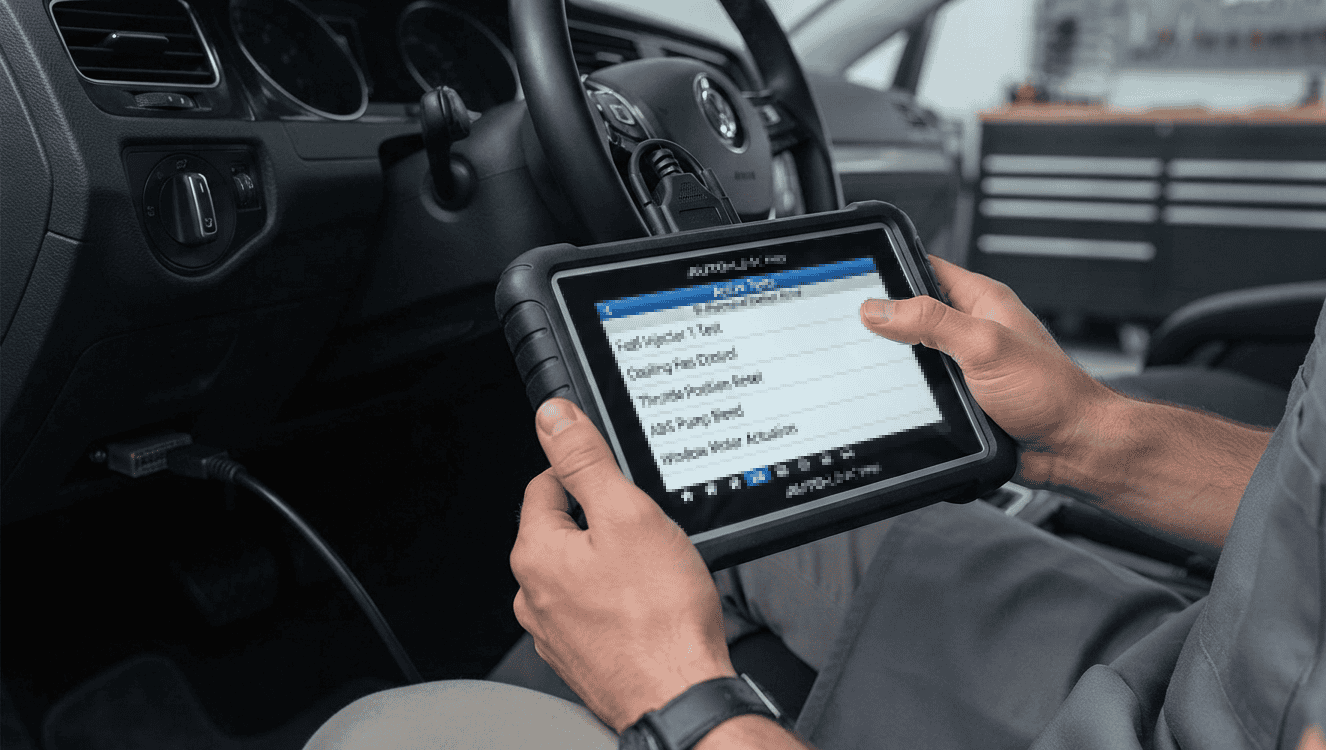
A bi-directional scan tool, sometimes called an active-test or two-way scanner, does not just read codes. It lets you send commands back to the car: cycle actuators, toggle a component on and off, and run guided tests like an ABS bleed, an injector kill test, or a cylinder cutout. That two-way conversation is the whole point. A basic code reader only listens to what the car reports. A bi-directional scan tool can tell a part to do something and watch what happens, which turns "here is a code" into "here is the actual failure." It is a tool for real diagnosis, not just for reading the check engine light.
That is the short version. The longer, honest version is that most car ads in 2026 push "bi-directional" as a must-have feature, and most of the buying guides ranking for this term are written by companies that sell the tools. So before you spend on one, it is worth understanding what active tests really do, which repair jobs genuinely need them, and which jobs a plain reader handles fine. Plenty of owners buy this capability and never open it once.
"Read codes" vs. "command components": the real difference
Every OBD2 device can pull a diagnostic trouble code (DTC) and, usually, clear it. That is one-way. The car talks, the tool listens.
Bi-directional control adds the reverse direction. Instead of only asking "what is wrong," the tool can say "turn this on" and confirm whether the part responds. In practical terms:
- A code reader tells you a fault exists (for example, an EVAP or O2 sensor code).
- A bi-directional scan tool lets you command the suspected part directly, so you can tell whether the part itself is dead, the wiring is broken, or the computer is simply reporting a fault from somewhere else.
That distinction matters most when a code points at a system rather than a single broken part. A misfire or an intermittent electrical gremlin can throw a code that does not name the real culprit. Commanding components one at a time is how you separate a bad part from bad wiring from a false alarm. If your check engine light is on but the car drives normally, that is a classic case where a code alone can send you chasing the wrong repair.
Active tests in practice: real examples
"Active test" is the umbrella term, and different brands label it differently (some say "active test," some say "actuator test," some say "bi-directional control"). They all mean the same thing: commanding a component from the scanner screen. Common examples include:
- Cycle the ABS pump / ABS bleed. After you replace a master cylinder, an ABS module, or brake lines, air can get trapped inside the ABS hydraulic unit where manual bleeding cannot reach it. The tool commands the module to open its internal valves and cycle the pump so trapped air is pushed out. This is one of the most-searched reasons people buy these tools.
- Injector kill / cylinder cutout test. Shut off one injector at a time to find a weak or dead cylinder on a rough-running engine.
- A/C compressor clutch engage. Command the clutch on to confirm whether an AC failure is the compressor, the clutch, or the control side.
- Cooling fan, fuel pump, and relay actuation. Turn each on directly to confirm the part works before you replace it.
- EVAP system test. Command the purge and vent valves to hunt an evaporative-emissions leak instead of guessing.
- Electronic parking brake service mode. Retract the caliper pistons so you can change rear pads on a car with an electric parking brake, which cannot be done by hand.
Beyond active tests, most tools at this level also add service resets (oil, brake, steering angle, TPMS relearn, throttle relearn). Those are not "bi-directional" in the strict sense, but they travel with the same tools and are often the real reason a DIYer buys one.
Who benefits, and who does not
Here is the part the seller-written guides tend to skip: most casual owners do not need a bi-directional scan tool. If your relationship with your car is "read the light, look up the code, clear it, maybe change a sensor," a good basic reader does that for a fraction of the outlay. Buying active tests you will never open is money spent on a feature, not a fix.
Use this as a rough decision guide:
| Job you want to do | Basic code reader is fine | You want bi-directional |
|---|---|---|
| Read and clear a check engine light | Yes | Not needed |
| Look up a code before a parts run | Yes | Not needed |
| Swap an obvious failed sensor | Usually | Optional |
| Bleed brakes on a car with ABS after a hydraulic repair | No | Yes |
| Change rear pads with an electronic parking brake | No | Yes |
| Diagnose a misfire down to one cylinder | Limited | Yes |
| Confirm a fan, pump, or A/C clutch before replacing it | No | Yes |
| Oil / brake / TPMS / steering-angle resets | No | Yes |
The honest test is this: if there is one job on the right-hand column you will actually do, the tool starts to make sense. If everything you do lives in the left column, save your money. New to this entirely? Learning to read and interpret codes first is the better starting point, and our guide to using an OBD2 scanner walks through that before you ever need active tests.
Simple cars vs. computer-heavy cars
The value also depends on what you drive. A simpler, older, mechanically straightforward car gives a bi-directional tool less to do, because fewer functions are gated behind the computer. A newer, module-heavy vehicle, especially a European one, buries more routine service behind electronic procedures (electronic parking brakes, adaptive resets, module relearns), so the same tool earns its keep faster. If you own something like a BMW where a lot of maintenance runs through the modules, capability and correct coverage matter more, which is why brand fit deserves its own attention. Our OBD2 scanner picks for BMW owners goes into that. Where the ceiling on all of this sits is a fair question too, and we take it up in when the jump to a professional scan tool is worth it.
Generic vs. OEM-level coverage (the caveat sellers gloss over)
A "bi-directional" label does not mean "does everything on every car." Two things vary a lot:
-
Which vehicles and protocols the tool supports. Depth of active-test coverage varies markedly by make and by tool. Newer vehicles from several brands use protocols like CAN FD and DoIP, and not every scanner communicates fully with them. Before buying, verify the specific tool supports your year, make, and model, not just "OBD2." A tool that reads codes on your car may still not run active tests on it.
-
The ceiling below dealer software. Even a capable aftermarket bi-directional tool stops short of some manufacturer-specific work. ECU reflashing (reprogramming), certain module initializations, and some security procedures still require OEM-level software and the right interface. That is normal. It is not a defect in the tool. It just means "bi-directional" and "does everything the dealer can" are not the same claim.
A safety note that matters
Active tests actuate real components. Commanding an ABS pump, releasing a parking-brake caliper, or firing an injector are not simulations, they move hardware. Anything touching brakes, airbags/SRS, or steering can hurt you or someone else if done out of sequence. Follow the manufacturer's service procedure for that specific test on that specific vehicle, work on a secured car, and if a procedure is beyond your comfort level, route it to a qualified mechanic. A scan tool makes a job possible; it does not make an unsafe shortcut safe.
What to look for in a capable tool
If the decision guide put you in the bi-directional column, judge tools on:
- Confirmed coverage for your vehicle, including the specific active tests and resets you care about, on your year and make.
- Protocol support for what you drive now and plan to drive (CAN FD, DoIP for newer vehicles).
- Update model. Software updates keep coverage current. Some tools include several years of updates; others charge annually. The renewal terms change the long-run cost as much as the tool itself, so read them before you buy.
- Form factor. A rugged tablet-style unit suits someone working in a driveway regularly; a phone-paired dongle suits lighter, occasional use.
- The specific functions you named earlier. Buy for the job on your list, not for the longest feature list.
Match the tool to the work you will actually do, verify it covers your car, and a bi-directional scan tool goes from a marketing buzzword to a genuinely useful piece of kit. Skip it, and a good code reader will serve you honestly for years.
FAQ
Can a bi-directional scan tool damage my car?
Not by reading data. The risk comes from active tests, which command real components. Run only the test that fits the job, follow the vehicle's service procedure, and keep brake, airbag, and steering procedures for someone qualified if you are unsure. Used correctly, it is safe; used out of sequence, actuating hardware can be dangerous.
Do I need a subscription to use one?
It depends on the tool. Some include a few years of software updates in the purchase, others charge a yearly renewal to keep vehicle coverage current. You can usually keep using an expired tool, but it will not gain support for newer vehicles or added functions. Check the update terms before buying, not after.
Will a Bluetooth scanner do bi-directional tests?
Some do, some do not. Bluetooth is just how the tool connects to your phone or tablet; it does not tell you whether active tests are included or whether they cover your car. Confirm the app and the specific device list bi-directional control for your make and model, rather than assuming the connection type implies the capability.
Is a bi-directional scan tool worth it for a DIY owner?
If you do your own brake work on a car with ABS or an electronic parking brake, chase misfires, or want to confirm parts before replacing them, yes, it can pay for itself by saving shop visits. If you mostly read and clear codes and swap the occasional sensor, a basic code reader is the smarter buy.
What is the difference between bi-directional control and OEM diagnostics?
Bi-directional control lets an aftermarket tool command components and run active tests across many makes. OEM diagnostics are the manufacturer's own software, which adds things like ECU reprogramming and certain module initializations that aftermarket tools generally cannot do. A capable bi-directional tool covers most everyday diagnosis; it does not fully replace dealer-level software.
1 thought on “What Is a Bi-Directional Scan Tool? Who Needs One”