
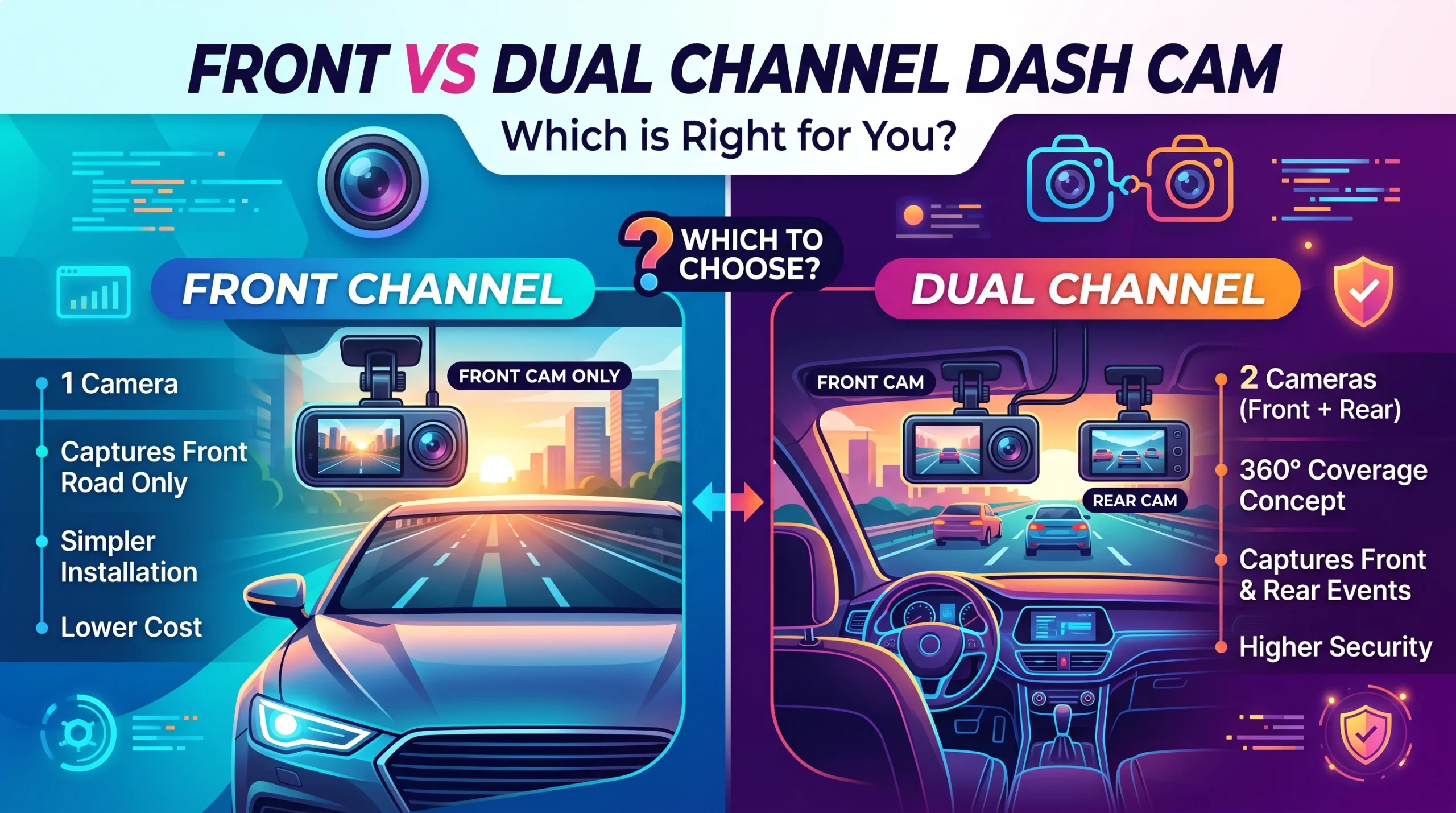
A front camera covers the incidents you can see coming. A rear camera covers being hit from behind, which is the situation where you have the least to say and the most need for evidence. A cabin camera covers what happens inside the car, which matters if you carry passengers for money and rarely otherwise. The decision is about coverage, not quality, and the honest cost of the second channel is not the hardware, it is the cable that has to travel the length of the car.
What each configuration actually covers
Front only. The road ahead, junctions, the car that pulled out, the debris you hit, the near miss you want to remember. This covers the majority of what people buy a dash cam for and it is a perfectly respectable place to stop.
Dual channel, front and rear. Adds the view behind, which is where being hit from behind, tailgating and reversing incidents live. Rear-end collisions are one of the most common incident types drivers experience, and they are also the one where fault is most often disputed after the fact by someone claiming you stopped without reason.
Three channel, adding a cabin camera. Records the interior. This is a working driver's configuration, and it brings consent and privacy questions with it that a road-facing camera does not, which we cover in cabin-facing cameras for rideshare, family and fleet use.
The three configurations side by side
The same three options, set against the things people actually choose on.
| Front only | Dual channel | Three channel | |
|---|---|---|---|
| What it records | The road ahead | The road ahead and the view behind | The road ahead, the view behind and the interior |
| Incidents it is bought for | Junctions, the car that pulled out, debris you hit, the near miss you want to remember | Being hit from behind, tailgating, reversing incidents | Disputes about what happened inside the vehicle |
| Installation | No cable run to the rear of the car | A cable from the windshield to the rear glass, along a headliner, down a pillar, under trim and often into a tailgate | The same rear cable run |
| Headline resolution | Describes the one channel you have | Often describes the front channel alone, since the rear is frequently a smaller, lower-specification module | Read the specification for each channel separately |
| Privacy and consent | Road-facing only | Road-facing only | Brings consent and privacy questions a road-facing camera does not, and obligations that vary by where you live |
| Who it suits | The majority of what people buy a dash cam for | Anyone who wants something behind them on record | Rideshare and taxi work, fleets, parents of new drivers |
The row that decides this for most people is the installation one rather than the coverage one, because the cable is bought and fitted once. The table carries no prices, because the point of this article is that the cost of a second channel is the cable run rather than the hardware, and that varies with the vehicle.
The cost nobody quotes: the second cable
The rear camera unit itself is usually the cheap part. What costs is getting a cable from the windshield to the rear glass, which means running it along a headliner, down a pillar, under trim and often into a tailgate, where it has to survive the hinge flexing every time the boot opens.
That is why "I will add the rear camera later" is a worse deal than it sounds. You are not deferring the hardware cost, you are deferring the whole installation and then doing it twice, because the front unit typically has to come down to connect the second channel. If there is a reasonable chance you will want two channels, buying two channels at the start is almost always cheaper in effort even if not in cash.
There is a middle route: some cameras support adding a rear channel later without replacing the front unit, and some people run a second, entirely independent camera at the back instead. Both have real trade-offs and we go through them in bundled rear camera versus a separate rear cam.
Where the third channel makes sense
Cabin cameras are bought for a reason, and the reason is almost always other people in the car.
- Rideshare and taxi work, where disputes about what happened inside the vehicle are a genuine occupational hazard.
- Fleet and company vehicles, usually as a policy decision rather than a driver's one.
- Parents of new drivers, where the honest framing is that this is a monitoring decision within a family and should be discussed as one rather than installed quietly.
If none of those describes you, a cabin camera mostly adds cost, another thing recording, and a set of privacy obligations that vary by where you live. It is the channel most often bought and least often used.
Quality dilution: what a bundled second camera usually is
Worth knowing before you compare two listings by channel count.
On most dual-channel packages the two cameras are not equals. The front unit carries the better sensor and the higher resolution; the rear unit is frequently a smaller, lower-specification module. That is a reasonable engineering choice, since the front view does more work, but it means a camera advertised at a headline resolution is often advertising the front channel only.
A second consequence: processing two channels at once is more work than processing one, and on some cameras the front channel's performance is not identical in dual-channel mode to what it would be alone. Read the specification for each channel separately rather than accepting the headline, and note what the camera does when recording both.
This is also where the resolution question gets more interesting than it first appears, and it is worth reading do you actually need 4K alongside this page rather than after it.
How to decide
- Start from incidents, not features. What do you want to have on record? If the answer includes anything behind you, you want two channels.
- Count the installation once. Decide now whether two channels is plausible, and buy accordingly. Retrofitting is the expensive path.
- Do not buy a third channel for a private car unless you have a specific reason you can name.
- Compare per-channel specifications, not headline numbers.
- Bigger vehicles change the math. A long wheelbase means a long cable run, a bigger windshield changes mounting, and the electrical system may not be twelve volts. Those are covered in dash cams for vans, trucks and RVs.
For where channel count sits relative to the decisions that actually determine reliability, see the dash cam buying guide.
FAQ
Is a rear dash cam worth it?
If you want evidence of being hit from behind, yes, because that is the incident where your own account carries least weight. The main cost is the cable run across the car rather than the camera itself.
Can I add a rear camera to my dash cam later?
Sometimes. Some cameras support a rear channel added afterwards; others do not, and a separate independent rear camera is the alternative. Either way you are doing the installation work later rather than avoiding it.
Is the rear camera the same quality as the front?
Usually not. On most dual-channel packages the front unit has the better sensor and higher resolution, and the advertised headline figure often describes the front channel alone. Check the specification for each channel.
Do I need a cabin-facing camera?
Only if you carry passengers for work, run a fleet, or have a specific family reason. Otherwise it adds cost and privacy obligations without covering an incident type most drivers experience.
Does a dual-channel camera use more power?
It records two streams and drives a second unit, so yes, somewhat, which matters mainly if you intend to run parking mode from the vehicle's battery. It is a consideration for how you power it rather than a reason not to buy it.
AutoGearZone does not sell dash cams and earns no commission from any brand or model named here. More on how we work on our about page.