
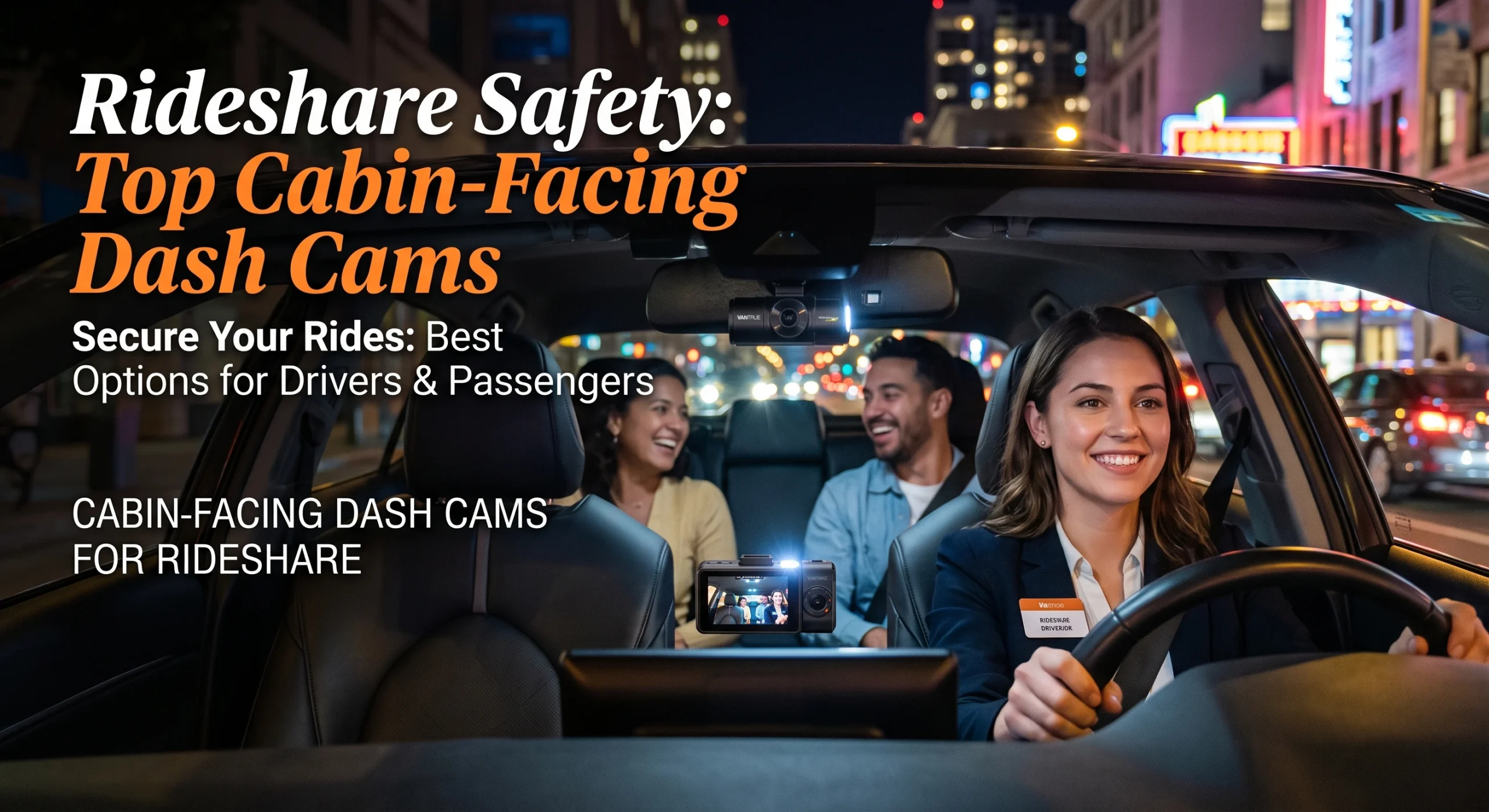
If you carry paying passengers, a cabin camera is a reasonable piece of equipment and many drivers who do this work consider it essential. If you do not, it mostly adds cost and obligations. The thing to settle before you buy is not which camera: it is what you are allowed to record where you live, particularly audio, because that is where the rules are sharpest and where they differ most between places.
Where a cabin camera genuinely earns its place
- Rideshare and taxi work. Disputes about what happened inside the vehicle are an occupational hazard, and the driver is usually the only person without a record. This is the clearest case.
- Fleet and company vehicles, where the decision is normally an employer's policy rather than an individual driver's, and where that policy has to be communicated to the people being recorded.
- Driving instruction and similar professional contexts, for much the same reasons.
- Families with a newly licensed driver. This one is a conversation rather than an installation. Fitting a camera to monitor a family member without telling them is a different act from agreeing together that it is there, and the second is the version that does not damage anything.
If none of those describes you, the honest answer is that a cabin camera is the channel most often bought and least often used, and the money is usually better spent on the front camera's sensor or on a decent rear channel, as covered in front-only, dual-channel or three-channel.
The consent question, and why audio is the sharp edge
A road-facing camera records the public street. A cabin camera records identifiable people inside a private space, usually including their conversation, and that is a materially different thing.
Rules on recording people, and specifically on recording audio, vary substantially between countries and, in some countries, between states or regions. Some places require every party to a conversation to consent. Others require only one. Some treat a vehicle carrying paying passengers differently from a private car. Data protection law may also apply to the recordings themselves once they exist, separately from whether you were permitted to make them. Rideshare platforms often have their own policies on top of all that, and those can be stricter than local law.
We are not going to tell you what your rules are. We do not know where you drive, and getting this wrong has consequences that a general article is not equipped to take responsibility for. What we will say is that this is the question to answer first, from your own jurisdiction's rules, your platform's policy and, if you carry passengers commercially, your own legal adviser. Our disclaimer applies to this page in particular.
The practical middle path many drivers take is to record video without audio, since the video answers most disputes and the audio is where most of the legal difficulty sits. Most cabin cameras allow audio to be switched off, and that is worth confirming before you buy.
What makes a cabin camera different technically
Infrared actually works here. A road-facing camera cannot use infrared illumination, because it cannot light a road and would reflect off the windshield. A cabin camera is pointed at a subject a meter away inside an enclosed space, which is exactly the situation infrared handles well. That is why cabin channels produce usable footage in a dark car while the road channel is relying on streetlights.
Field of view has a different job. The camera needs to see the whole cabin, or at least the seats that matter, from a mounting position that is usually close to the subjects. Wide is appropriate here in a way it often is not facing forward.
Resolution matters less. You are identifying people and actions at close range rather than reading a number plate at distance.
It is another stream to process and store, which affects heat, card consumption and how long your loop retains footage.
Notice, storage and the things to decide before you switch it on
Whatever your local rules turn out to be, a few decisions are worth making deliberately rather than by default:
- Tell people. A visible notice in the vehicle is normal practice in commercial passenger work and removes most of the awkwardness. Recording people who do not know is the version that causes problems, legal and otherwise.
- Decide on audio explicitly. On or off, chosen, not left at whatever the camera shipped with.
- Know where the footage goes. If the camera syncs to a phone app or a cloud service, another party is holding recordings of identifiable people, which is worth understanding before you enable it. The app side is covered in the app is half the product.
- Decide how long you keep clips. Loop recording deletes by default, which is often the right answer. Saving and archiving footage of passengers is a deliberate act with its own obligations.
- Consider what else is being logged. A camera with GPS is also recording where those people traveled, which is covered in what the location data adds.
Our own privacy policy covers how this site handles data; it does not cover your vehicle, and nothing here is a substitute for the rules that apply where you drive.
FAQ
Do rideshare drivers need an interior dash cam?
Many consider it essential, because disputes about what happened inside the vehicle are common and the driver is otherwise the only party without a record. Whether you may use one, and on what terms, depends on your jurisdiction and your platform's policy.
Is it legal to record passengers in my car?
It depends entirely on where you drive, and audio recording in particular is treated very differently between places. Check your own jurisdiction's rules, your platform's policy, and take advice if you carry passengers commercially.
Should I record audio in the cabin?
Many drivers switch audio off, because video answers most disputes and audio is where most of the legal difficulty sits. Whether you may record it at all is a local question.
Do cabin cameras work in the dark?
Yes, generally well, because they use infrared illumination and the subject is close. This is the one place infrared is genuinely useful on a dash cam; a road-facing camera cannot use it.
Do I have to tell passengers they are being recorded?
In many places, yes, and it is good practice regardless. A visible notice in the vehicle is normal in commercial passenger work. What is required of you specifically is a question for your jurisdiction.
AutoGearZone does not sell dash cams and earns no commission from any brand or model named here. More on how we work on our about page.