
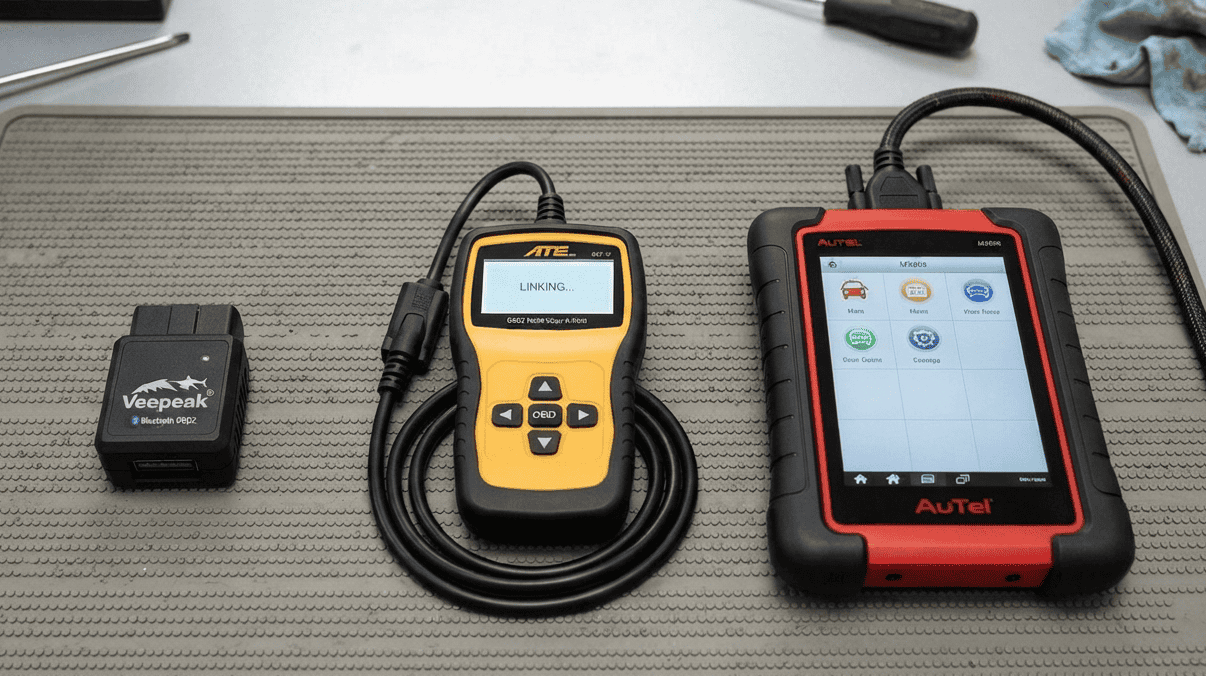
On vehicles with an intelligent charging strategy, the car keeps a running estimate of how worn its battery is and adjusts charging accordingly. Fit a new battery without telling the car, and it carries on charging as though the old, aged one were still there. Registration is the procedure that resets that estimate. It needs a tool with the specific function for your make, and the first thing worth establishing is whether your car needs it at all, because many do not.
What battery registration actually is
It is not a repair and it is not a code clear. It is a message to the vehicle's power management system saying: the battery has been replaced, start your ageing calculation again.
Cars that do this are managing charging actively rather than applying a fixed regime. They track how much the battery has been through, and they trim charging behavior as it ages, partly for battery longevity and partly for fuel economy, since running the alternator harder costs fuel. That estimate is useful right up until the moment the battery underneath it is no longer the same battery.
Registration is normally performed through the diagnostic port using a tool that supports the manufacturer's own service function. It is a manufacturer-specific operation rather than a standardized one, which puts it in the same category as everything else outside the OBD2 mandate, as described in scanner brand coverage.
Registration versus coding: not the same operation
These two get used interchangeably and they are different, which causes real confusion when someone follows the wrong instruction.
Registration tells the car that a new battery of the same specification has been fitted. It resets the ageing estimate.
Coding tells the car that a battery of a different type has been fitted, for example a change between chemistries or between capacities. That changes how the car should charge it, not just how worn it thinks it is.
If you replace like with like, registration is generally the operation. If you have changed type, the vehicle may need to be told what it now has, and doing only half of that leaves the car charging the new battery on the old assumptions. Which battery is correct for your vehicle is a specification question and not one we answer here; your vehicle's own documentation and a supplier working from it are the right source, and sister sites in our network cover fitment specifications rather than us.
Does your car need it?
Most cars on the road do not, and this is the question to settle before buying any tool.
As a general pattern, registration applies to vehicles with intelligent or managed charging systems, and those are disproportionately more recent European models, with BMW being the make readers ask about most often. It is also common on vehicles with stop-start systems, since those work the battery harder and depend on knowing its condition.
The way to find out is not a general article. It is your vehicle's own service documentation, or a dealer or independent specialist for your make. If your car does not use a managed charging strategy, there is nothing to register and no tool to buy.
BMW owners in particular will find this is one item on a longer list of manufacturer service functions, and the broader picture for that make is in choosing a scanner for a BMW.
Which tools can do it
Registration is a write operation, not a read, so it sits with tools that can perform service functions rather than with basic readers. Practically:
- Brand-specific tools and apps are frequently the cheapest route if you only own one make, and are often the ones the owner communities recommend.
- Mid-range and professional multi-brand tools commonly list battery registration among their service functions. Check that it is listed for your make specifically, not just as a feature of the tool.
- Basic code readers cannot do it. Reading and clearing codes is a different class of operation entirely.
The general capability boundary between reading and commanding is worth understanding before you shop, and we set it out in who actually needs a bi-directional scan tool.
What happens if you skip it
Nothing dramatic and nothing immediate, which is why plenty of people skip it and report no problems. The consequence is slower and less visible: the car continues charging the new battery on a strategy tuned for a worn one, which over time is not what the new battery wants and can shorten its useful life. On stop-start vehicles, drivers sometimes notice the system behaving inconsistently.
This matters more in a cold climate than a mild one, because a battery in deep cold has less margin to give away in the first place, and a battery that has been charged on the wrong assumptions has less to offer on a January morning. The cold side of that story is in car batteries in the cold.
If the car is not starting reliably, or a warning has appeared after a battery change, that is a diagnosis question rather than a tooling question, and it belongs with a qualified auto electrician. Please read our disclaimer. Within our own network, faults and warning lights are autoartificer.com's territory rather than ours, and we say that in words rather than linking across sites.
FAQ
Does every car need battery registration after a battery change?
No, and most do not. It applies to vehicles with intelligent or managed charging strategies, which are disproportionately recent European models and vehicles with stop-start systems. Your vehicle's service documentation is the reliable answer for your car.
What happens if I do not register a new battery?
The car keeps charging as though the old battery were still fitted, which is not ideal for the new one and can shorten its life. There is usually no immediate symptom, which is why the omission often goes unnoticed.
Is battery registration the same as battery coding?
No. Registration says a new battery of the same type has been fitted. Coding says a battery of a different type has been fitted and changes how the car should charge it. Changing battery type usually needs both considered.
Can a cheap OBD2 reader register a battery?
No. Registration is a manufacturer-specific service function, not a standardized read, so it requires a tool that supports that function for your make.
Can I register a battery myself?
If you have a tool that supports the function for your vehicle, the procedure itself is usually straightforward. Whether it is the right operation, and whether coding is also needed, depends on your car and on what you fitted, and your vehicle's documentation is the source that applies.
AutoGearZone does not sell scanners or batteries and earns no commission from any brand or tool named here. More on how we work on our about page.