
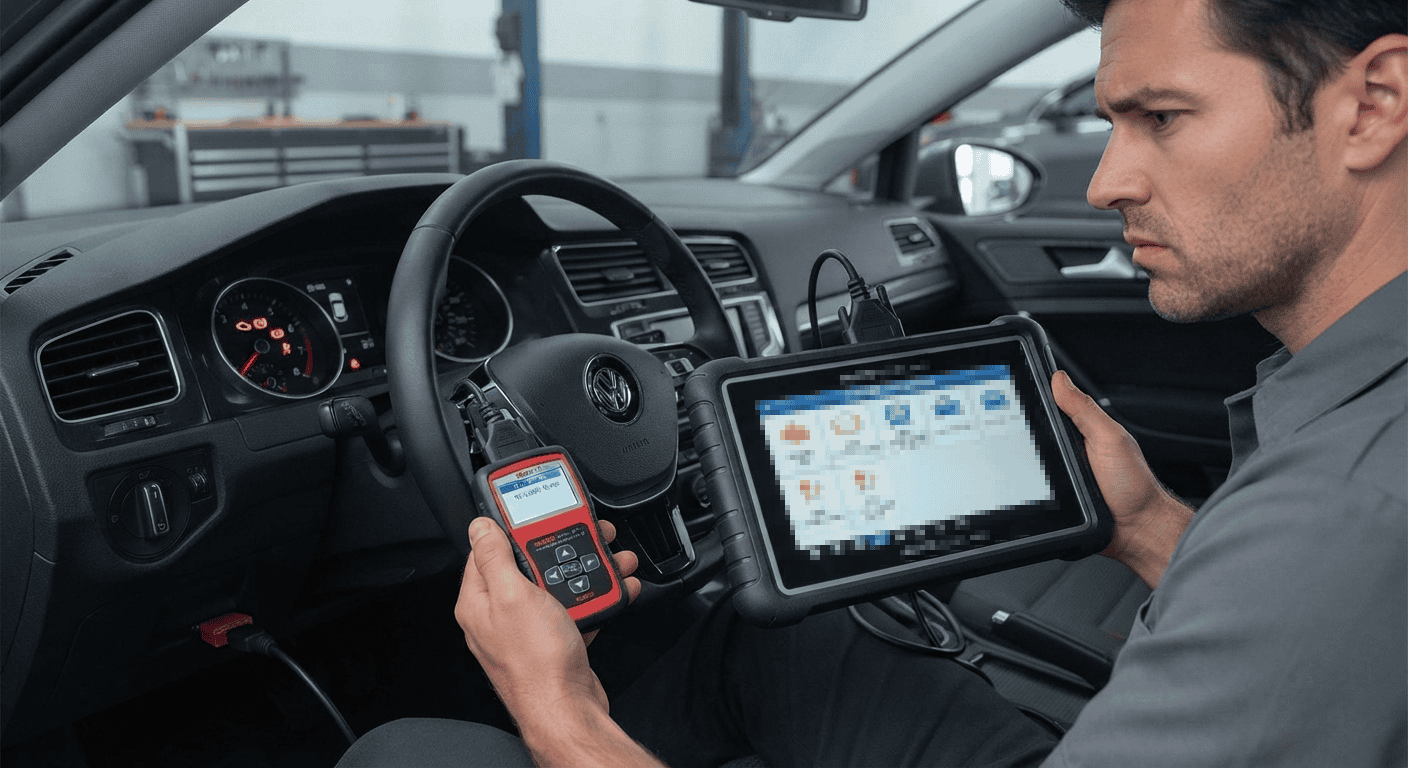
If your ABS or airbag light is on and your scanner reports no codes found, the scanner is not lying and it is not broken. It is telling you there are no faults in the one area it is allowed to look. OBD2 guarantees access to emissions-related powertrain data and nothing else, so brakes, airbags and much of the transmission sit outside its scope. A basic reader will report an empty result on a car that has stored faults in those modules, and that empty result is a false negative rather than an all-clear.
Why the standard stops at the powertrain
OBD2 exists because of emissions regulation. That single fact explains the boundary. Regulators needed a standard way to confirm that a vehicle's emissions control systems were working, so they mandated a common connector, common protocols and a common set of powertrain data. They had no reason to mandate access to the anti-lock braking module, and so they did not.
Everything outside that mandate is at the manufacturer's discretion. The modules exist, they store faults, they communicate over the vehicle's networks, and they are reachable through the same physical port. But the language they speak is manufacturer-defined, and a tool can only speak it if it was deliberately built to. That is the same architecture we describe in scanner brand coverage, seen from a different angle: coverage is not one dimension but two, which vehicle and which system.
What "no codes found" actually means on a basic reader
Read it as: no emissions-related powertrain faults are currently stored. That is genuinely useful information, and for a check engine light it is often the whole answer.
It is not the answer to any of these:
- An ABS or traction control light
- An airbag or SRS light
- A transmission warning on many vehicles
- A tyre pressure monitoring light
- A steering, suspension or driver-assist warning
If one of those is lit and your tool reports nothing, you have learned that the fault is not in the powertrain. You have not learned that there is no fault. This distinction is worth teaching yourself early, and our first plug-in walkthrough frames reading a result as a starting point rather than a verdict for the same reason.
The three systems people most often hit this wall on
ABS and stability control. The module stores its own faults, commonly relating to wheel speed sensors, the hydraulic unit or the control module itself. None of it is exposed through generic OBD2. A tool needs specific ABS support, and on many vehicles that support is brand-specific rather than universal.
SRS and airbags. Same situation, with an important extra: this is not a system to experiment with. Airbag systems contain stored energy and pyrotechnic devices, and diagnostic or repair work on them is properly a job for someone trained and equipped for it. A tool that reads SRS codes tells you what the module recorded. It does not make the system safe to work on, and we are not going to pretend otherwise.
Transmission. Partly visible through generic OBD2 on some vehicles, largely manufacturer-specific in practice, and one of the most common sources of "my scanner sees something but not the thing I need."
What kind of tool does see them
Broadly, three routes, and none of them is defined by price alone:
- Handhelds and app tools that explicitly list ABS and SRS support. Look for the systems named individually in the specification, and check that your make is listed for those systems rather than just for engine.
- Brand-focused tools and apps. A tool built around one manufacturer often reaches deeper into that brand's modules than a generalist costing more.
- Professional-class tablets, which typically offer full system scanning across many makes. Whether that is proportionate for a home owner is a real question and we take it up in when the jump from a budget tool to a professional one is worth it.
If your interest goes beyond reading a stored code into commanding a component to test it, that is a separate capability again, covered in who actually needs a bi-directional scan tool. And if you are buying your first tool and none of this applies yet, the ordinary criteria in choosing a beginner scanner still hold.
The safety part, stated plainly
An ABS light means some part of the anti-lock braking system has been disabled or has reported a fault. An airbag light generally means the restraint system may not deploy as intended. Neither is a warning to sit on because a cheap reader found nothing.
We are a gear and tooling site. We can tell you why your tool cannot see the fault and what class of tool can. We cannot tell you what the fault is, and reading a code from a brake or restraint system is not the same as knowing it is safe to keep driving. Get it looked at by a qualified mechanic. Within our own network, warning-light and symptom interpretation belongs to autoartificer.com rather than to us, which we say in words rather than sending you across sites with a link. Please also read our disclaimer, which applies to everything on this site and particularly to pages like this one.
FAQ
Why does my OBD2 scanner say no codes when the ABS light is on?
Because generic OBD2 only covers emissions-related powertrain data. The ABS module stores its faults outside that scope, so a reader limited to the standard genuinely finds nothing, even though the fault is there.
Do I need a special scanner to read airbag codes?
Yes, a tool with explicit SRS support for your make. Note that reading the code and working on the system are different things; airbag systems contain pyrotechnic components and are properly handled by someone trained for them.
Can any scanner read transmission codes?
Some transmission data is visible through generic OBD2 on some vehicles, but much of it is manufacturer-specific. If transmission diagnostics matter to you, check that the tool lists transmission support for your specific make and model rather than in general.
Is an expensive scanner guaranteed to read ABS and SRS?
No. Price correlates with breadth but does not guarantee it for your vehicle. Check the published system-level coverage for your exact make, model and year before buying.
My warning light is on but everything feels normal. Can I keep driving?
That is not a question a scan tool answers, and it is not one we will answer for you. A brake or restraint warning means a safety system has reported a problem with itself. Have it assessed by a qualified mechanic.
AutoGearZone does not sell scanners and earns no commission from any brand or tool named here. More on how we work on our about page.