
For most people who own one or two cars and want to know why a light is on, the answer is no. A professional-class tablet is an extraordinary piece of equipment, and it is built for someone who sees forty unfamiliar vehicles a month, needs manufacturer service functions across many makes, and can absorb an annual subscription as a business cost. Buy one for a driveway and the most likely outcome is a capable tool used twice a year at a fraction of its ability.
What this page is. We are comparing documented capability tiers and how this market is structured. We have not owned and campaigned a professional tablet across a fleet, and we are not going to write as though we had. Where we describe what a tier gives you, that is drawn from what these products document about themselves, not from a test bench.
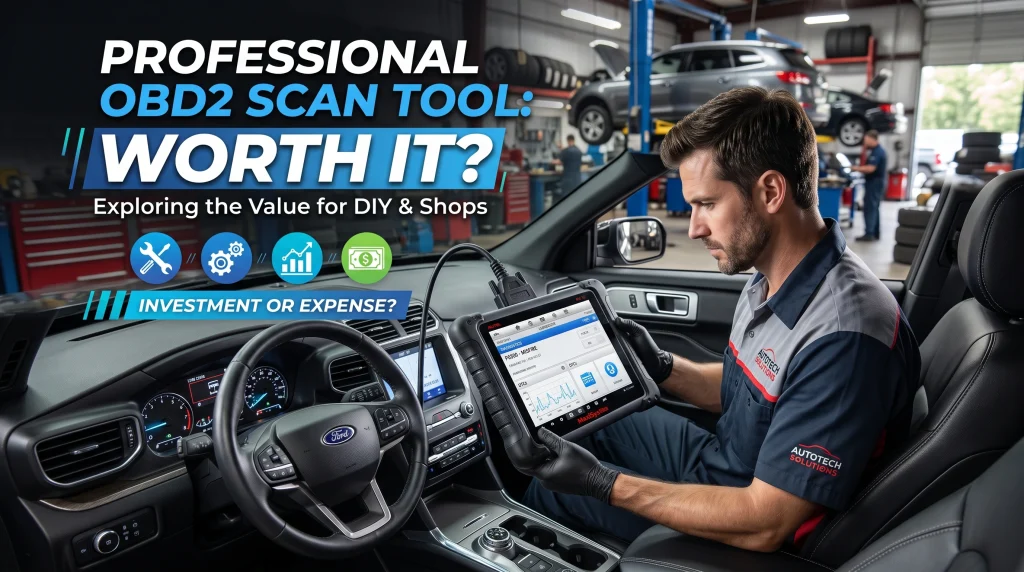
The four tiers, and what each dividing line actually is
The prices in the heading are shorthand for tiers rather than claims about today’s market, and the boundaries move. What is stable is what separates the tiers.
Budget readers. Read and clear generic emissions codes, show freeze frame and readiness. The dividing line above this tier is access to systems other than the powertrain.
Mid-range handhelds and app tools. Add live data with usable presentation, and often ABS and SRS on at least some makes. The dividing line above this tier is the ability to command rather than only observe.
Prosumer and enthusiast tools. Add bi-directional control and a set of service functions: brake bleeding routines, service resets, battery registration on supported makes. Often strongest on one or two brands. The dividing line above this tier is breadth across makes plus manufacturer-level procedures.
Professional tablets. Full system scanning across many manufacturers, extensive service and programming functions, guided diagnostics, and a subscription that keeps all of it current.
Two of those dividing lines have their own pages, because they are the two most people actually hit: system access in why cheap readers cannot see ABS, SRS and transmission codes, and command capability in who actually needs a bi-directional scan tool.
What the money genuinely buys
- Breadth across manufacturers. This is the single largest difference and the one that justifies the price for a workshop. A generalist that reaches deep into thirty makes is a much harder thing to build than one that reaches deep into one.
- Service and programming functions that a home owner meets perhaps twice: module programming, adaptations after a component change, guided procedures.
- Guided diagnostics and documentation, which is often the real product. Knowing which test to run next is worth more than the ability to run it.
- Speed. A full system scan of an unfamiliar car in a few minutes is a professional requirement and a home-owner luxury.
- Support and updates that keep it current, which is also where the ongoing cost lives.
What it does not buy
It does not buy you the ability to diagnose. A better tool gives you more information; interpreting it is a separate skill, and a professional tablet in inexperienced hands produces more data to misread rather than fewer questions.
It does not buy you access to everything. Some manufacturer procedures remain dealer-only, and security access requirements on newer vehicles are an active constraint even for professionals.
It does not buy you a fixed asset. Coverage and function depth depend on staying subscribed, and letting that lapse converts a professional tool into a very expensive mid-range one. That structure is worth reading before purchase, not after, and it is set out in what scanner subscriptions actually cover.
And it does not buy you time. These tools have a real learning curve, and it is designed for someone who uses the tool daily.
Who should buy one
- People who work on cars for money. The case is straightforward and this page is not aimed at you.
- People maintaining a genuinely mixed fleet, several makes, several ages, all of them their responsibility.
- Serious hobbyists who have already outgrown a prosumer tool and can name the specific function they are missing. If you can name it, you have the strongest possible reason to buy.
- Clubs and shared ownership groups, where the cost and the learning are spread across several people and the tool actually gets used.
If you cannot name the function you are missing, that is the clearest signal available that the next tier is not yet your constraint.
The cheaper answers most people should try first
- Buy for your make, not for the market. A brand-focused tool frequently reaches deeper into your car than a generalist costing several times more. Coverage is two-dimensional, which vehicle and which system, and we explain that in scanner brand coverage.
- Buy the tier that solves your actual complaint. If the complaint is “my reader cannot see the ABS light,” the fix is system access, not a tablet.
- Pay a workshop for the one procedure you need. A single visit for a coding job is cheaper than a tool and a subscription, and you are also buying the experience to interpret the result.
- Start at the bottom and find your own limit. A budget reader tells you within a few months exactly which capability you keep wishing for, and that is better information than any buying guide, ours included. The criteria are in choosing a beginner scanner.
FAQ
Is a professional scan tool worth it for a home mechanic?
Usually not. The breadth of manufacturer coverage and service functions that justify the cost are aimed at someone working on many unfamiliar vehicles. Most home owners are better served by a tool matched to their own make.
What can a professional scan tool do that a cheap one cannot?
Read every module rather than the powertrain alone, command components, perform manufacturer service and programming procedures, and do it across many makes. The last of those is the largest single difference.
Do professional scan tools need a subscription?
Typically yes, for coverage and function updates. Letting it lapse generally does not disable the tool, but it stops it learning about new vehicles, which is most of what you were paying for.
Will a better scanner tell me what is wrong with my car?
It will give you more information about what the car has recorded. Turning that into a diagnosis is a separate skill, and a more capable tool does not supply it.
Should I buy a professional tool to save money on garage visits?
Rarely, once the subscription and the learning curve are counted. Paying for the occasional procedure you cannot do yourself is usually cheaper, and it includes the interpretation.
AutoGearZone does not sell scanners and earns no commission from any brand or tool named here. More on how we work on our about page.