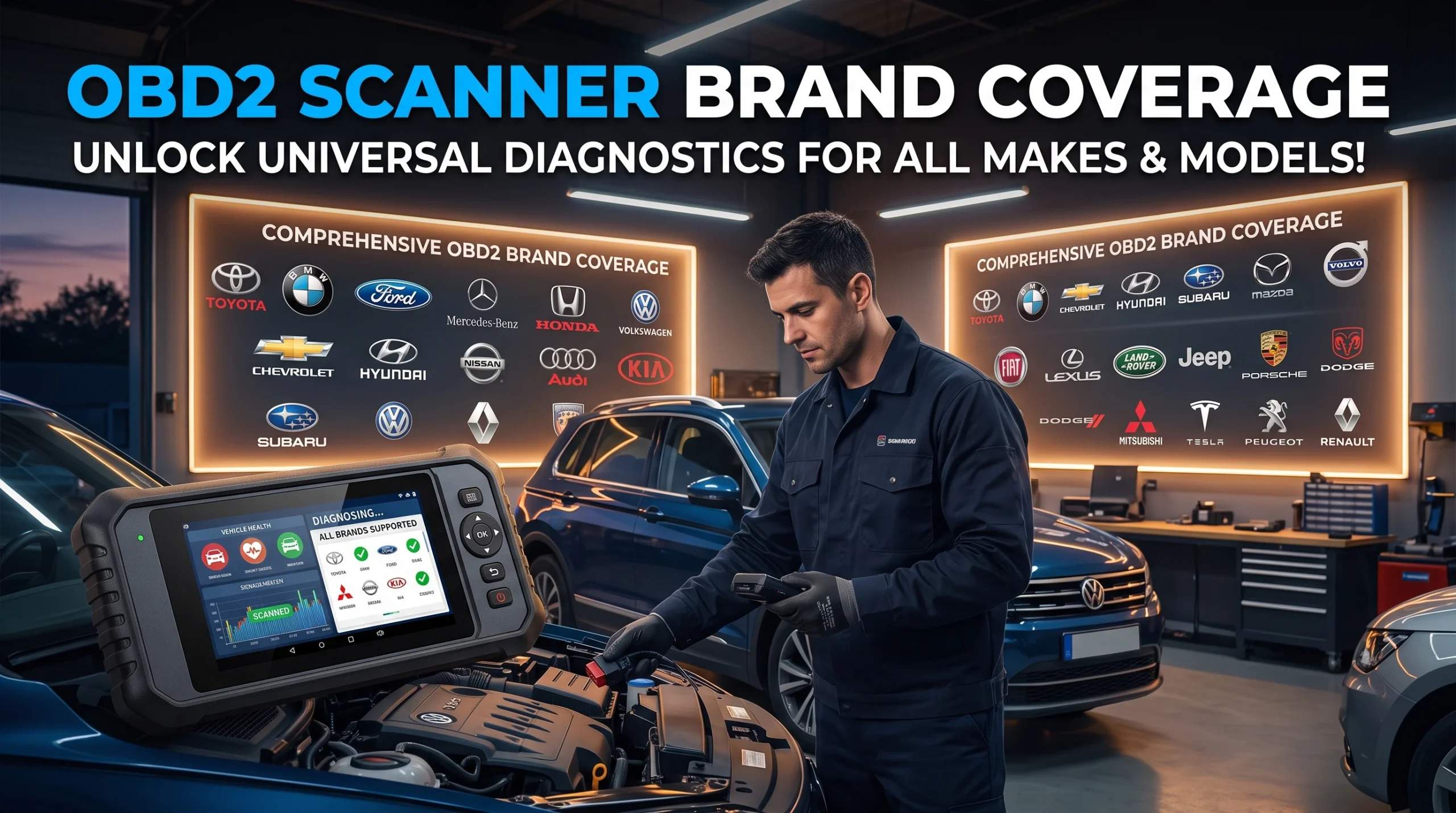
“Works on all OBD2 vehicles” is usually true and usually useless. The OBD2 standard guarantees that every compliant car exposes the same emissions-related powertrain data through the same connector, so any scanner can read that layer on any compliant car. Everything else in your vehicle, including ABS, airbags, transmission and body modules, sits outside that guarantee and is reached through manufacturer-specific protocols the tool has to be built for, brand by brand.
What the standard actually guarantees, and where it stops
OBD2 is an emissions regulation that happened to give us a diagnostic port. That origin explains almost everything confusing about coverage. The standard mandates a common connector, a common set of communication protocols, and a common set of powertrain data relating to emissions. It does not mandate that a manufacturer expose anything else, and most of what you actually want to know about a modern car lives in the part that was never standardized.
So when a listing says a tool works on all OBD2 vehicles, read it as: this tool can read the emissions-related engine data that every car is legally required to publish. That is a genuinely useful layer, and for a check engine light it is often the only layer you need. It is also perhaps a tenth of what a dealer tool sees. Our guide to what OBD2 compliance means for your model year covers the entry condition; this page covers what happens after you are through the door.
Generic codes versus manufacturer-specific codes
Fault codes are split into two groups, and the split is the clearest example of the standard’s boundary.
Generic codes are defined by the standard itself. A generic powertrain code means the same thing on a Ford, a Volkswagen and a Toyota, because the definition is published and shared. These are the codes every scanner, including the cheapest reader, can look up and display in plain language.
Manufacturer-specific codes are defined by the carmaker and are only meaningful within that brand. The same code number can describe two entirely unrelated circuits on two different makes. A scanner can only translate these if the maker’s definitions were built into it, which is exactly what “brand coverage” is buying you.
This is why two people with the same tool have opposite experiences. One got a generic code and a clear description. The other got a manufacturer-specific code and a screen that said only the code number, or worse, an incorrect generic guess. The tool did not fail; it hit the edge of what it was built to know. Reading the code correctly is only half of it, and interpreting what a code actually implies about the car is a separate skill from operating the tool, which is why our first plug-in walkthrough keeps the two apart.
Where the real differences live: modules outside the powertrain
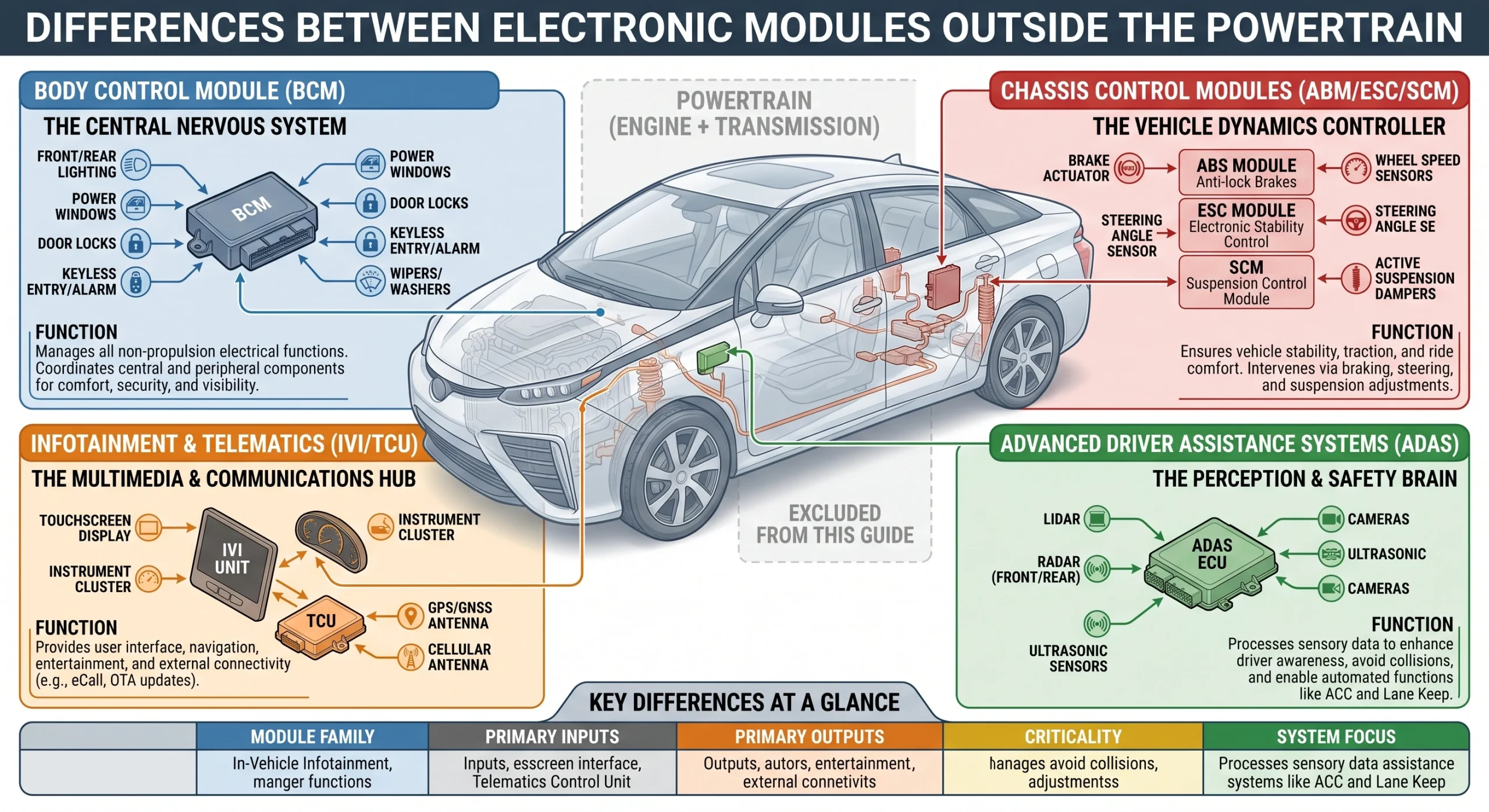
The gap widens fast once you leave the engine. A modern car has dozens of control modules, and OBD2 gives you a right of access to almost none of them:
- ABS and stability control. Not covered by the standard. A tool needs specific support to read wheel speed sensor faults or hydraulic module codes.
- Airbags and restraints. Not covered. Many budget tools cannot see this system at all on any brand.
- Transmission. Partly covered on some vehicles, largely manufacturer-specific in practice.
- Body, comfort and infotainment modules. Entirely outside the standard.
We cover the practical consequences of this gap in more depth in why cheap readers cannot see ABS, SRS and transmission codes. The short version is that “no codes found” from a basic reader does not mean the car has no stored faults. It means the reader looked in the one room it has a key to.
Why the brands people complain about are the brands they complain about
European makes come up disproportionately in coverage complaints, and there is a structural reason rather than a conspiratorial one. Brands that build more modules into a car, and that use more proprietary service functions like coding, adaptation and component registration, simply have more territory sitting outside the standard. Reading a fault is one thing; performing a manufacturer service routine afterward is another, and the second almost never travels across brands.
BMW is the case readers ask about most often, and it gets its own treatment in our BMW scanner guide, because the questions there are usually about coding and registration rather than about reading a code at all. The same reasoning applies to other makes with deep proprietary toolchains.
There is a second, newer axis to this as well. Some recent vehicles have moved their diagnostic traffic to faster protocols, and a tool without the right hardware can connect and still return nothing. That is a different failure from a coverage gap, and we separate the two in the protocol your scanner has to speak.
How to check coverage for your car before you buy
- Look for a vehicle coverage list or lookup tool published by the maker of the scanner, and check your exact make, model and year rather than the brand alone. Coverage is usually declared per platform, not per badge.
- Check coverage per system, not just per car. A tool may list your vehicle and still support only engine and transmission on it, with no ABS or SRS.
- Treat “supports all 10 OBD2 modes” as a statement about the standard, not about your brand. It tells you the tool implements the public protocol well. It says nothing about manufacturer-specific access.
- Ask whether coverage expands with updates, and whether those updates are included or paid. Coverage is not a fixed property of a tool; it grows as the maker documents more platforms.
- Match the tool to the job. If you want a code read on a common make, coverage is rarely the constraint, and our beginner scanner criteria apply as written.
Coverage lists change with almost every firmware release, so treat anything you read, here included, as a starting point for a check rather than a substitute for one.
FAQ
Does OBD2 mean every scanner works on every car?
For emissions-related powertrain data, broadly yes, on any compliant vehicle. For anything else, no. The standard covers a defined slice of the car, and manufacturer-specific systems sit outside it and require deliberate support from the tool.
Why did my scanner show a code number but no description?
That is the usual sign of a manufacturer-specific code the tool does not have definitions for. It could read the raw code from the module but had nothing to translate it against, so it showed the number alone.
Is a more expensive scanner always better on coverage?
Not automatically. Price often correlates with breadth, but a mid-range tool built around one brand can beat a pricier generalist on that brand. Check the published coverage for your specific vehicle rather than using price as a proxy.
My scanner says no codes found but the warning light is on. Is it broken?
Not necessarily. If the light relates to a system outside the standard, such as ABS or airbags, a scanner limited to generic powertrain data will genuinely find nothing. A tool with access to those modules may find a stored code immediately.
Does brand coverage change after I buy the tool?
It can, in both directions. Makers add platforms through firmware and database updates, so coverage generally expands over the life of a supported tool, and stops expanding entirely once support ends.
AutoGearZone does not sell scanners and earns no commission from any brand or tool named here. More on how we work on our about page.