
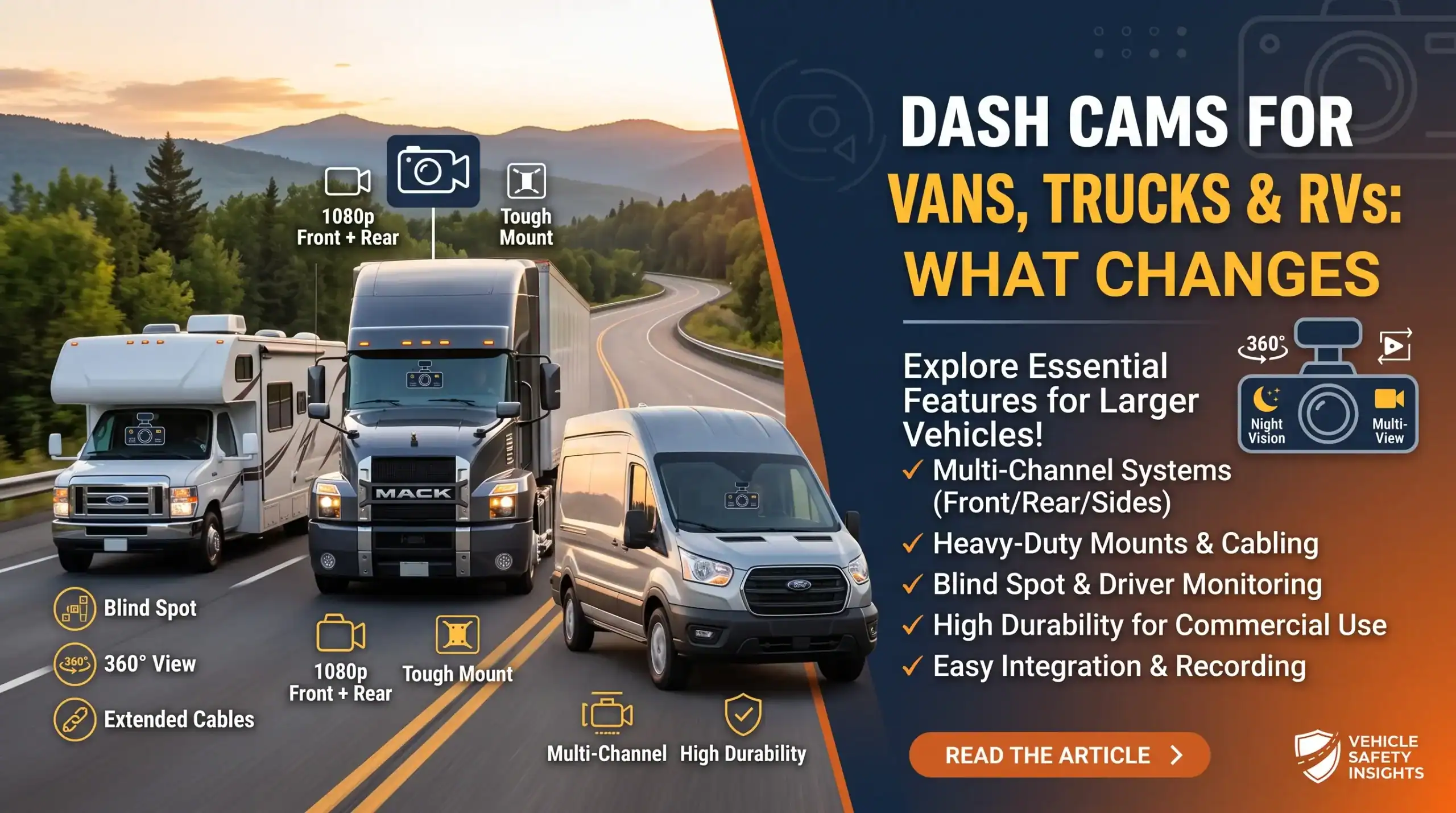
Everything in a normal dash cam guide still applies, and then four things change. The vehicle may run at twenty-four volts rather than twelve, which is not a detail. Every cable run is longer. There may be no rear window at all, which changes what a rear camera even means. And a parked motorhome may have people asleep in it, which changes what parking mode is for. Sort those four and the rest of the buying decision is the ordinary one.
The voltage question
Cars and light vans generally run twelve-volt electrical systems. Many larger commercial vehicles, trucks and some motorhomes run twenty-four volt systems.
This matters absolutely, because connecting a device built for one to the other is not a compatibility inconvenience, it is a way to destroy the device and potentially cause a fire. Some dash cams and hardwire kits are rated for both; many are not, and the rating is something to confirm from the product's own documentation rather than assume.
Motorhomes add a further complication, because they frequently have two electrical systems: the vehicle's own, and a separate habitation system for the living area, sometimes with different characteristics and its own batteries. Which one a camera should be connected to is not a question to answer by guesswork.
We are not going to give wiring instructions here. On a vehicle of this kind, with these voltages and these systems, the right answer is a qualified auto electrician, and for motorhome habitation electrics a specialist in those systems. Our disclaimer applies and applies firmly.
Distance: everything is further away
A rear camera on a hatchback is a short cable run. On a long-wheelbase van, a box body or a motorhome, it can be several times that, and length is not free: longer runs mean more voltage drop, more places to secure the cable, more trim to remove, and in an articulated or towed configuration a joint that has to be disconnectable.
The practical consequences:
- Check the maximum supported cable length for any two-channel system before buying. Many are specified for car-sized vehicles.
- Extension cables are not always supported, and using an unsupported one can produce a rear channel that works intermittently or not at all.
- A second independent camera at the rear is a much stronger option here than on a car, because it removes the long run entirely. The trade-offs are in bundled rear camera versus a separate rear cam.
- The camera is further from the front of the vehicle in a cab-forward van or a large motorhome, which changes framing and makes a wider field of view more defensible than it would be on a car, as discussed in field of view.
When there is no rear window
A panel van, a box body or many motorhomes have no rear glass, so a conventional rear channel has nowhere to look through.
The alternatives are an externally mounted camera, which has to be weatherproof and properly rated for outdoor mounting, or a camera inside a load area, which mostly shows you the load area. External mounting brings its own considerations: weather sealing, vibration, the cable entry point through the body, and the fact that an external camera is exposed to everything the road throws at it.
This is also where the rear channel's purpose is worth re-examining. On a car, a rear camera is largely about being hit from behind. On a large vehicle, the more common wish is a reversing view or coverage of the sides during manoeuvres, and those are different products with different mounting positions. Deciding what you actually want recorded, before shopping, is the advice in front-only, dual-channel or three-channel.
Parked, and sometimes occupied
Parking mode on a car assumes an empty vehicle. On a motorhome it frequently does not, and that changes two things.
Battery is a bigger consideration, in both directions. These vehicles often have more battery capacity available, which helps, but they also spend far longer parked away from a charging opportunity, which does not. A camera drawing continuously for a week of wild camping is a different proposition from one drawing overnight on a driveway.
Anything recording inside becomes a privacy question. A camera covering a living area is recording people in what is, at that moment, their accommodation. If anyone other than you uses the vehicle, that is a conversation to have rather than an installation to make quietly, and the general considerations are in cabin-facing cameras.
If the vehicle is used commercially, there may be obligations about recording that apply to you as an operator. Those vary by jurisdiction and by the kind of work, and they are a question for your own rules rather than for us.
What to look for
- A stated voltage rating covering your vehicle's system, confirmed from the product's documentation.
- A stated maximum cable length for two-channel systems, checked against your vehicle rather than assumed.
- A weatherproof rating on anything mounted outside.
- A power arrangement suited to long parked periods, decided with an auto electrician who has seen your vehicle.
- Everything from the ordinary buying order, which does not change: power source, card, channels, then video capability, as set out in the dash cam buying guide.
FAQ
Can I use a car dash cam in a truck or RV?
The camera itself is often fine. What matters is the power arrangement: if the vehicle runs a twenty-four volt system, a twelve-volt device needs equipment rated for it, and getting that wrong can destroy the device or worse.
Do dash cams work on 24V systems?
Some are rated for both twelve and twenty-four volts, and some hardwire kits are too. Many are not. Confirm the rating from the product's own documentation and have the installation done by a qualified auto electrician.
How do I fit a rear camera to a van with no rear window?
Either an externally mounted, properly weatherproofed camera, or a second independent camera positioned where it has a view. Both need a cable entry through the body, which is work for someone who will seal it correctly.
Is a wider field of view better on a large vehicle?
More defensible than on a car, because the camera sits further back and the vehicle is wider, so there is more to cover. The trade against detail still applies.
Should a motorhome dash cam run in parking mode?
It can, and the vehicle often has more battery capacity available, but it also spends longer away from charging. The power arrangement should be planned for how you actually use the vehicle, with someone who knows its electrical systems.
AutoGearZone does not sell dash cams and earns no commission from any brand or model named here. More on how we work on our about page.