
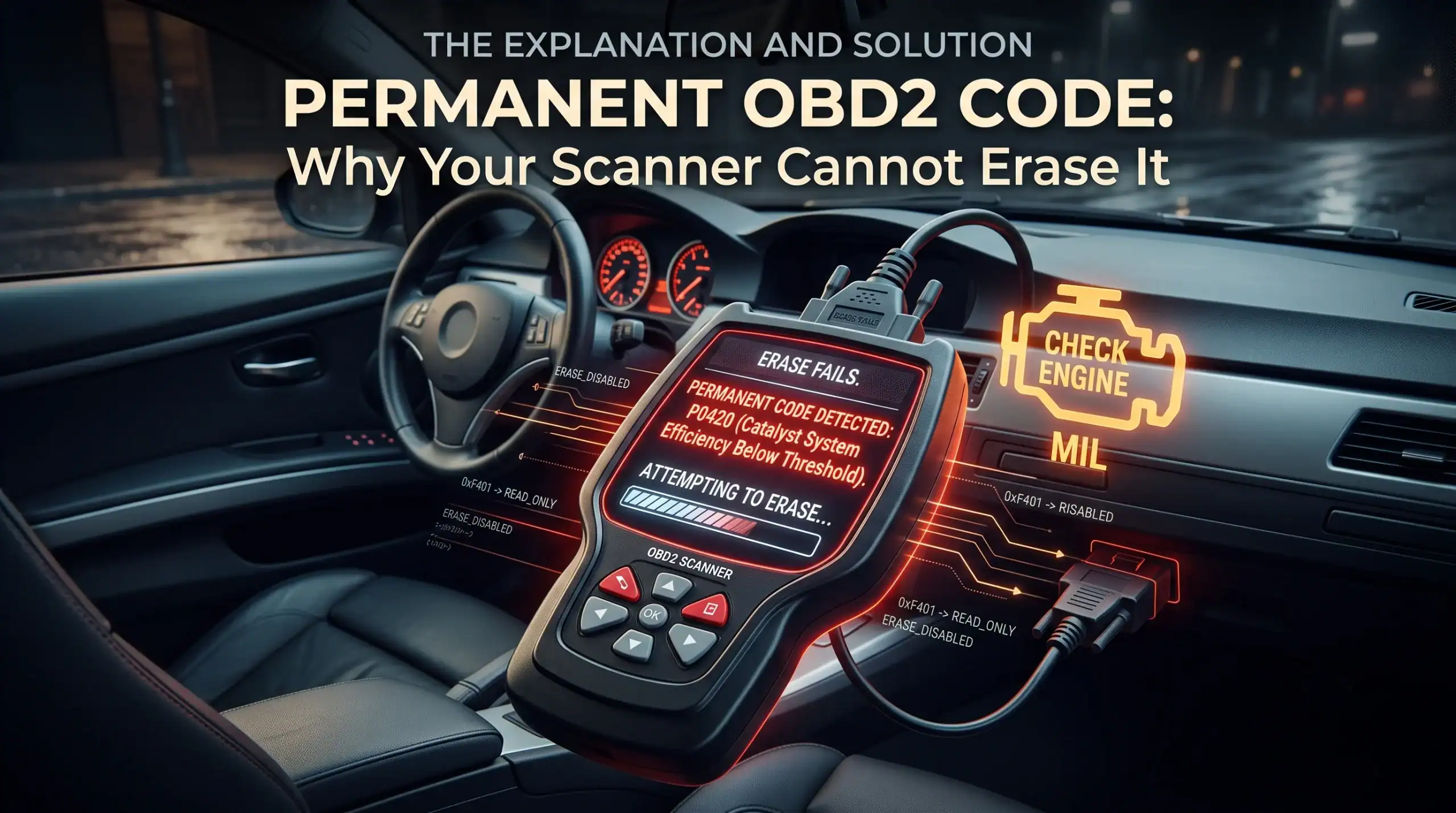
Your scanner is working correctly. A permanent diagnostic trouble code, usually shortened to PDTC, is deliberately designed so that no scan tool can erase it. The clear command every scanner sends is restricted to active and pending codes; permanent codes are excluded from it by regulation. A permanent code clears only when the vehicle's own monitor re-runs the relevant test and finds the fault gone. There is no tool, no trick and no product that shortcuts this.
What a permanent code is, and why it exists
A permanent code is a copy of an emissions-related fault, written to a part of the module's memory that the clear function cannot reach. It exists alongside the ordinary stored code rather than instead of it, so on a scanner that displays both you may see the same fault twice, once as a regular code and once flagged as permanent.
The reason it exists is regulatory rather than technical. Permanent DTCs were mandated for vehicles from the 2010 model year onward by the US Environmental Protection Agency and the California Air Resources Board, and their purpose was to close a specific loophole: drivers clearing an emissions fault immediately before an inspection so the car presented itself as healthy without anything having been repaired. California's Bureau of Automotive Repair has published its own guidance to the trade on how these codes behave, because the change caught out plenty of professionals too.
Put plainly, the permanent code exists so that the car keeps its own record of an emissions problem that only the car itself can close.
Why no scan tool can clear one
The clear function in OBD2 is a defined request, and its scope is defined with it. That request is limited to active and pending diagnostic trouble codes. Permanent codes are outside its scope, so a compliant tool sending a compliant clear command will erase everything it is permitted to erase and leave the permanent code exactly where it was.
This is worth restating because the search results for this question are full of pages promising to clear permanent codes quickly. Some of them are describing the ordinary clear function and mislabeling it. What is true is:
- Sending the clear command again will not work. It is not a matter of trying harder or of a better tool.
- A more expensive scanner will not work either. Professional tablets are subject to the same restriction. This is not a coverage or capability gap.
- Disconnecting the battery will not work. Permanent codes are stored in non-volatile memory specifically so that power loss does not erase them. This was the workaround for ordinary codes on many older vehicles, and it does not carry over.
If your tool cleared the other codes and left one behind, that is the system behaving exactly as designed. Distinguishing a tool limitation from a designed refusal is worth doing before you go shopping for a bigger tool, and the general question of which tools see what is covered in scanner brand coverage.
How a permanent code actually clears
There is exactly one route, and it has two parts.
Fix the underlying fault. Whatever set the original code has to actually be repaired. This site is a gear and tooling guide rather than a repair-diagnosis service, and what a given code implies about your particular car is a question for a qualified mechanic or for dedicated fault-interpretation resources. Within our own network that lane belongs to autoartificer.com rather than to us, which we say in words rather than sending you off-site.
Then drive the car enough for the monitor to run again. The permanent code does not clear at the moment of repair. It clears when the vehicle's own self-test for that system runs, completes, and finds no fault. That requires the car to be driven under whatever conditions that particular monitor needs, which differs by monitor and by vehicle. Some run readily in ordinary driving; others need a specific combination of temperature, speed and duration.
We are deliberately not printing a number of miles or a number of drive cycles here, because the honest answer is that it depends on the monitor and the vehicle, and any single figure would be wrong for most readers. Your vehicle's own service documentation is the source that applies to you.
What this means before an emissions test
Two practical consequences, and they pull in opposite directions.
First, a permanent code present at the time of an inspection is generally treated as a fault the vehicle still has, because that is precisely what it was designed to signal. Clearing the ordinary codes does not hide it.
Second, and less obviously, the driving needed to clear a permanent code is also the driving that sets your readiness monitors, and those two things arrive together. Presenting a car too soon after a repair risks a rejection for incomplete monitors even if the repair was sound. That interaction is covered in readiness monitors and drive cycles before an emissions test, and the broader question of whether to clear anything at all is in should you clear OBD2 codes.
Rules differ by jurisdiction and by model year, so check your own testing authority's current requirements rather than planning around a general description. Before you clear anything, read the freeze frame snapshot attached to the fault; it is the context you cannot get back afterward.
FAQ
What is a permanent OBD2 code?
It is an emissions-related fault code stored in non-volatile memory that a scan tool cannot erase. It was mandated from the 2010 model year by the EPA and CARB so that clearing codes before an inspection could not hide an unrepaired emissions fault.
Why can my scanner clear some codes but not others?
Because the OBD2 clear request is defined to cover active and pending codes only. Permanent codes are excluded from it by design, so a correctly functioning scanner will clear the first two categories and leave the third untouched.
Will disconnecting the battery clear a permanent code?
No. Permanent codes are held in non-volatile memory precisely so that removing power does not erase them. Battery disconnection was a workaround for ordinary stored codes on many older vehicles and does not apply here.
How long does it take for a permanent code to clear itself?
It clears once the relevant monitor has re-run and found no fault, which depends on the monitor and on your driving. Some monitors complete in ordinary use; others need particular conditions. Your vehicle's service documentation is the reliable source for what yours requires.
Do I need a professional scan tool to deal with permanent codes?
No, and one would not help. The restriction applies equally to inexpensive readers and to professional tablets. A better tool may show you more about the underlying fault, but no tool can erase a permanent code.
AutoGearZone does not sell scanners and earns no commission from any brand or tool named here. More on how we work on our about page.