
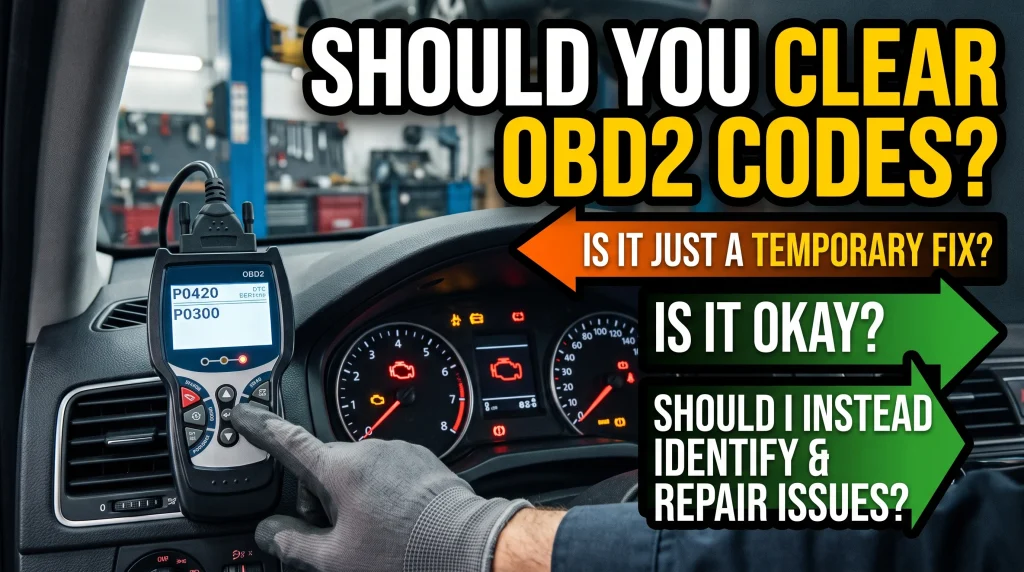
Clearing a code turns off the warning light and erases the stored fault. It does not repair anything. If the condition that set the code is still present, the car will detect it again and the light will come back, usually within a few days of normal driving. Clearing is worth doing after a repair, to confirm a fix, or to establish a clean baseline. It is worth avoiding when it destroys information you have not read yet.
What clearing actually does, and does not do
The clear function sends a single request to the car asking it to erase stored emissions-related diagnostic information. The car complies. Codes go, the light goes, and on most vehicles the freeze frame and the readiness monitor status go with them.
What does not happen is any change to the car. A loose connector is still loose, a failing sensor is still failing, and the monitor that caught it the first time will run again and catch it again. The only genuine difference between before and after is that you can no longer see what the car had already worked out.
This is worth being blunt about because the button is right next to the read function on nearly every tool, and the temptation to press it is strong. Our first plug-in walkthrough puts reading and clearing in separate steps for exactly this reason.
What you lose the moment you clear
Three things, all of them useful, all of them unrecoverable:
- The code itself, unless you wrote it down. Photograph the screen before touching anything.
- The freeze frame. The snapshot of what the car was doing when the fault registered, which is often more informative than the code number. Reading it first takes ten seconds and is covered in freeze frame data.
- Readiness monitor status. Clearing resets the car's self-test monitors to "not ready," and they only return to ready after the vehicle has run through the relevant drive conditions again. This is the one that quietly costs people money, and it has its own page in readiness monitors and drive cycles.
There is also a category of code that will not clear no matter what you send, by regulatory design rather than tool failure. That mechanism is a separate question and we answer it in why your scanner refuses to erase permanent codes.
When clearing is the right move
- After a repair. This is the main legitimate use. Fix the cause, clear the code, drive the car, and see whether it returns. Without clearing, you have no way to tell a stale stored code from a live recurring one.
- To establish a baseline on a car you just bought. Read everything first, record it, then clear and drive. Anything that comes back within the next few hundred miles is current rather than historical.
- After confirming an obviously transient cause. A code set by a genuinely one-off event, a loose fuel cap being the classic example, may not need anything beyond correcting the cause and clearing.
- When a workshop asks you to, as part of a documented diagnostic process where they know what they are looking for.
In every one of those, reading and recording comes first, and clearing comes second.
When it is the wrong move
- Before you have read the freeze frame. You are erasing the most useful screen on the tool to save yourself thirty seconds.
- As a way to make a light go away. The light is the car's only channel for telling you something. Silencing it does not change the condition, and it does change your ability to notice when the condition gets worse.
- Before selling a car, to hide a fault. Beyond the ethics, it usually does not work: monitors reset to not-ready, which is itself visible to any buyer with a scanner, and the code typically returns.
- When the warning is one you should not be driving on at all. A flashing check engine light in particular is a different signal from a steady one on most vehicles, and it is not something to clear and carry on with. If you are unsure what your car's warning means, stop and ask a qualified mechanic rather than a scan tool.
We are a gear and tooling site, not a repair-diagnosis service. What a specific code or warning light means about your particular car is a fault-interpretation question, and within our own network that is autoartificer.com's territory rather than ours; we mention that in words rather than sending you off-site with a link. For anything with a safety dimension, please read our disclaimer and talk to a qualified mechanic.
The emissions-test trap
This is the practical consequence people meet most often, and it is worth stating on its own.
Clearing codes shortly before an emissions test is close to the worst possible timing. The codes go, but so does readiness monitor status, and a vehicle presented with too many monitors still reporting "not ready" is generally rejected on that basis, regardless of whether it would have passed on emissions. The number of incomplete monitors tolerated depends on the vehicle's model year and on the jurisdiction, and at least one US state has moved to requiring all monitors set. Check your own testing authority's current rules before you plan around this.
Recovering readiness takes driving under the right conditions, which can be a matter of days rather than minutes. If a test is imminent, clearing is the last thing you want to do.
FAQ
Does clearing an OBD2 code fix the problem?
No. It erases the stored record and turns off the light. The underlying condition is unchanged, and if it is still present the car's monitors will detect it again and the light will return.
How long until the check engine light comes back after clearing?
It depends on how often the relevant monitor runs, which varies by fault type and by driving conditions. For many faults it is a matter of days of normal driving; some monitors need specific conditions and take longer.
Can I clear codes by disconnecting the battery?
On many older vehicles that worked, though it also wipes other learned settings and stored preferences. On modern vehicles it is unreliable and, for permanent codes, ineffective. It is a blunt instrument with side effects, and a scan tool's clear function is the cleaner route.
Will clearing codes make my car pass an emissions test?
It is more likely to cause a rejection than a pass, because clearing also resets readiness monitors and a vehicle with too many incomplete monitors is generally not accepted for testing. Requirements vary by jurisdiction and model year.
Should I clear a code before taking the car to a mechanic?
Generally no. The stored codes and freeze frame are diagnostic information the mechanic can use, and erasing them makes their job harder and potentially more expensive.
AutoGearZone does not sell scanners and earns no commission from any brand or tool named here. More on how we work on our about page.