
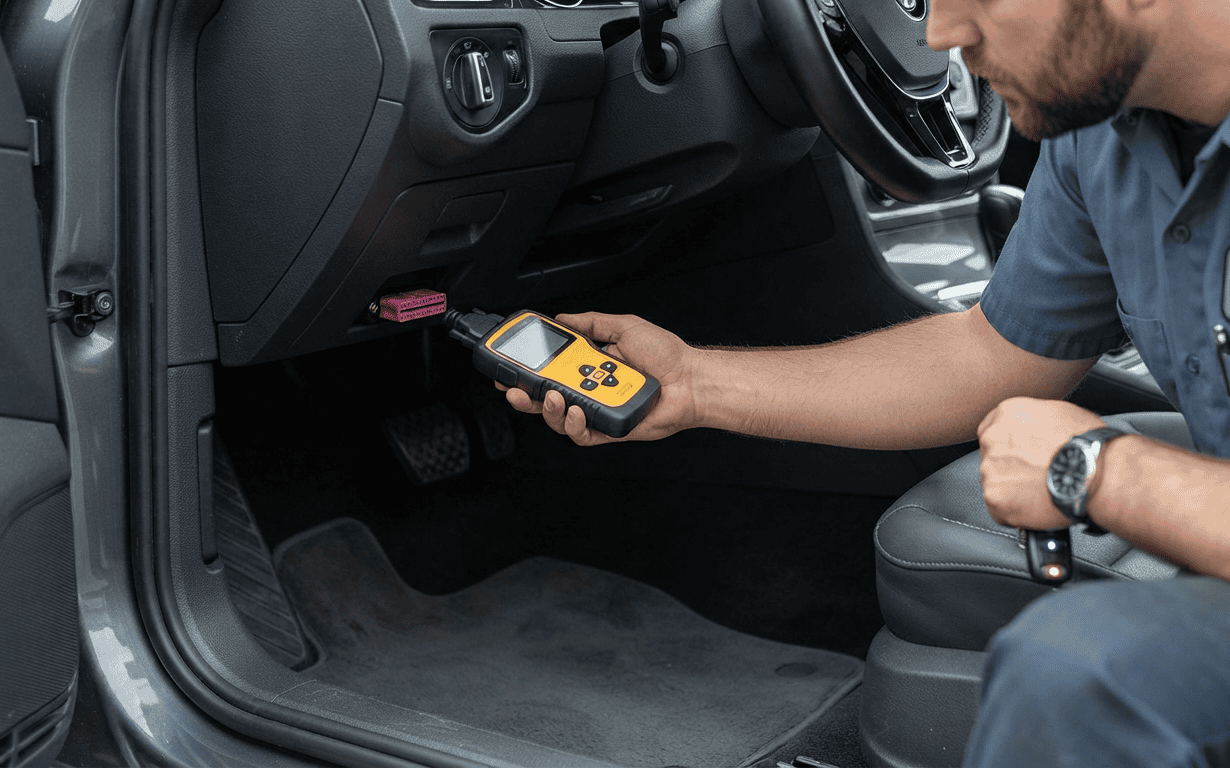
Two different questions get asked as one. Plugging a scanner into the port to read codes is a normal, low-risk operation and is not going to damage a healthy car. Leaving a wireless adapter permanently plugged in is a different matter: some continue drawing current after the engine is off, and on a car that sits for days or weeks, that is a genuine way to come back to a battery that will not start it.
Can plugging in a scanner damage your car?
For ordinary use, no. The port is designed to be connected to, the connection is standardized, and reading codes and live data is a passive request-and-answer conversation. Doing it with the ignition on and the engine off, which is what most tools ask for, is what the system expects.
The exceptions worth knowing are narrow and mostly about what a tool is asked to do rather than that it is connected:
- Commanding components. Tools that can actuate parts, rather than only read from them, can make things happen that the car did not ask for. That is a capability worth respecting rather than fearing, and it is covered in who actually needs a bi-directional scan tool.
- Interrupting a write operation. Coding, programming or module updates are the one genuinely risky category, because losing power or connection midway can leave a module in a bad state. This is why those procedures come with stability warnings.
- Physically damaged or badly made hardware. A bent pin or a poorly built adapter is a hardware problem, not an OBD2 problem, but it is real.
None of that applies to plugging in a reader and looking at a code, which is the thing most people are actually asking about. If you have not done it before, the first plug-in walkthrough covers the sequence.
Why some adapters drain and others do not
The OBD2 port supplies power continuously on most vehicles, including when the ignition is off. That is by design, so a tool can wake modules and so that memory is retained. It also means anything left in the port has a power source whether the car is running or not.
What an adapter does with that power varies enormously:
- Some go into a genuine low-power sleep when they detect the vehicle is off, and draw very little.
- Some stay awake indefinitely, holding a wireless radio ready to pair. This is the category that causes problems.
- Some have a physical switch or auto-sleep that can be configured.
Handheld tools that you plug in, use, and unplug are not part of this conversation at all, which is one of the quiet advantages of that format and one of several covered in Bluetooth dongle or handheld scanner.
We are deliberately not printing a current figure here. Draw varies by adapter, by firmware, and by what the vehicle does after shutdown, and any single number we published would be wrong for most readers and would sound authoritative anyway. The manufacturer's own documentation for your specific adapter is the source that applies to you.
The variable that decides it: how long the car sits
This is why two people with the same adapter have completely different experiences and both are telling the truth.
A car driven every day is having its battery replenished constantly, and a small parasitic draw never gets the chance to accumulate. The same draw on a car parked for three weeks at an airport has three weeks to work with. Add a battery that is a few years old and a cold snap, and the margin that was invisible becomes the reason the car will not turn over.
There is a compounding factor in winter, because cold reduces the capacity a battery can actually deliver at the same time as it increases what starting demands. So the parked-in-December case is meaningfully worse than the same parked-in-June case. We treat cold and car electronics generally in using a scanner in the cold.
If your car is already showing starting problems, that is not a scanner question, and we are not going to guess at it. Battery condition, charging system health and parasitic draw hunting are jobs for a qualified auto electrician with the right equipment. Please read our disclaimer; within our own network, diagnosing a car that has started misbehaving belongs with autoartificer.com rather than with us, which we say in words rather than linking across sites.
What to do about it
- Unplug it if the car is going to sit. The simplest answer and the one that always works. Airport parking, a weekend car, a seasonal vehicle: take it out.
- Check whether your adapter has a sleep mode, and whether it needs enabling. Some do it automatically, some need a setting changed in the app, some do not have it.
- Prefer an adapter that documents its standby behavior. A maker that publishes it has thought about it. Silence on the subject is not reassurance.
- Consider a switched extension or a port with a physical switch if you genuinely want it permanently fitted. These exist precisely because this problem is common.
- Treat a battery that is already marginal as the real issue. An adapter does not usually kill a healthy battery on a daily driver. It finishes off a tired one. Products for keeping a parked car's battery topped up exist and are a reasonable answer to the underlying problem, but they are a different subject from scan tools and not one this site covers.
If you use a phone-based setup, the adapter is the part that stays in the car, so this applies to you more than to handheld owners; the wider trade-offs of that route are in OBD2 apps compared.
FAQ
Can I leave an OBD2 Bluetooth adapter plugged in all the time?
On a car driven regularly, many people do without incident. On a car that sits for extended periods, it is a real risk, because some adapters continue drawing current with the ignition off. Check your adapter's documented standby behavior.
Will using a scanner damage my car's computer?
Reading codes and live data will not. The genuine risk sits with write operations such as coding or module programming, where an interruption partway through can leave a module in a bad state.
How long can a car sit with an adapter plugged in before the battery goes flat?
There is no general answer, and anyone giving you a number is guessing. It depends on the adapter's standby draw, the battery's age and condition, the vehicle's own quiescent draw and the temperature. If the car will sit, unplug it.
Does the OBD2 port stay powered when the car is off?
On most vehicles, yes. That is deliberate, so tools can wake modules and so memory is retained. It is also why anything left plugged in has a power source regardless of ignition state.
My car will not start after leaving a scanner plugged in. What now?
Treat it as a battery and charging system question rather than a scanner question, and have it checked by a qualified auto electrician. A single flat battery is not necessarily damaged, but repeated deep discharge is hard on one.
AutoGearZone does not sell scanners or adapters and earns no commission from any brand or tool named here. More on how we work on our about page.