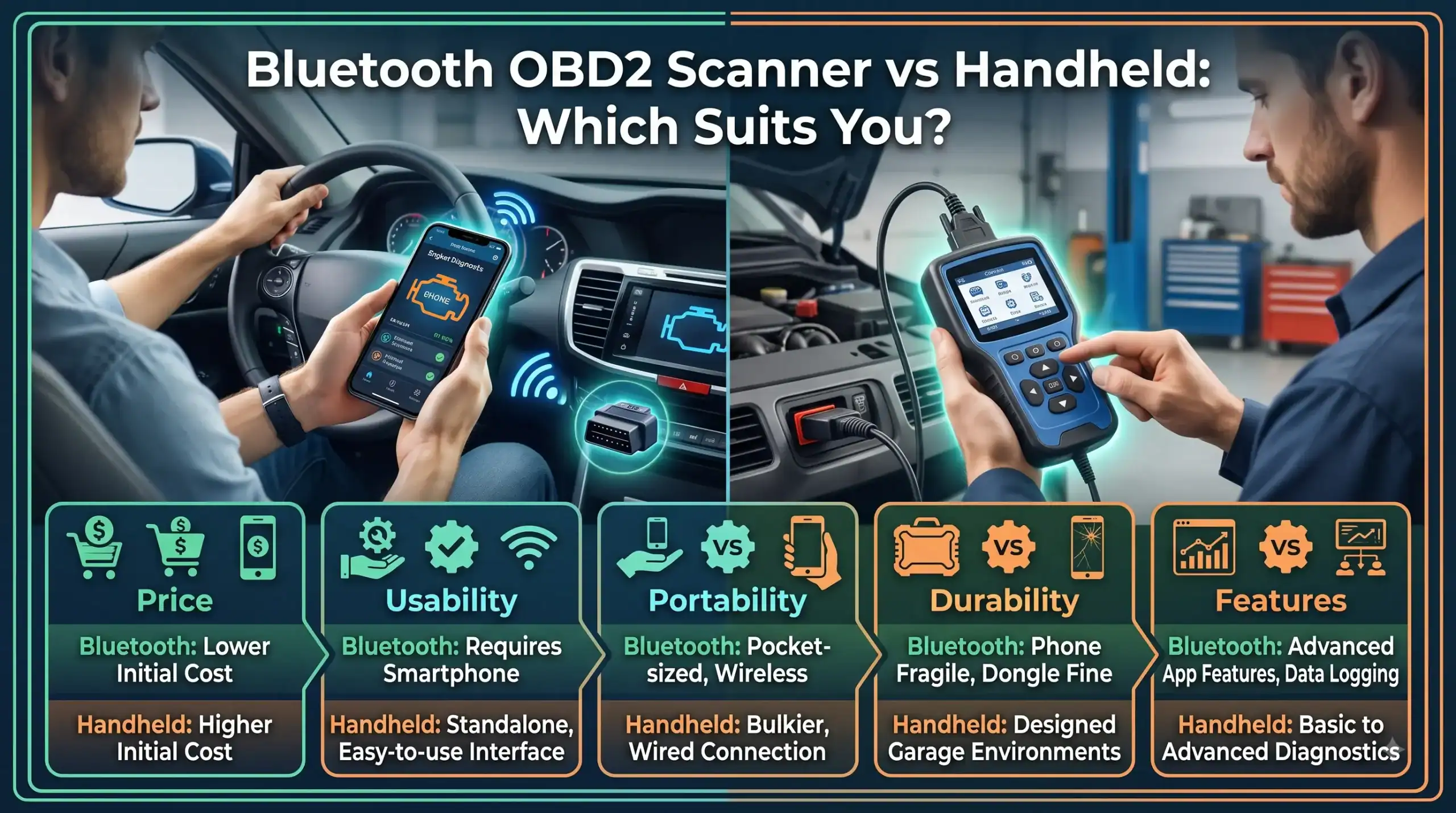
A Bluetooth OBD2 adapter and a handheld scanner can read and clear the exact same codes. The difference between them is not diagnostic depth, it is workflow. A Bluetooth dongle plugs into the port and hands the interface to an app on your phone: compact, cheap, and only as good as the app behind it. A handheld scanner is self-contained, with its own screen and buttons, more rugged and not dependent on your phone's battery or a paired connection. Neither is the objectively better tool. The right one is whichever fits how you actually check your car.
The two things that are actually the same
Before getting into the differences, it is worth being clear about what does not change between the two formats:
- Both read and clear the same generic OBD2 codes, because they are talking to the same standardized diagnostic layer under the hood.
- Both can show freeze-frame data, the snapshot of engine conditions captured when a code set, covered in full in our guide to using an OBD2 scanner.
- Neither format alone determines whether the tool supports live data or bidirectional control. Those are separate capabilities that exist in both Bluetooth and handheld products; format and capability are two different purchasing decisions people often conflate.
Where a Bluetooth adapter wins
- Cost. A Bluetooth dongle is typically the cheaper way into code reading, because it leans on hardware you already own (your phone) instead of packaging its own screen.
- Portability. It is small enough to leave in the glovebox permanently, and setup after the first pairing is usually just opening the app.
- Interface quality. A phone screen is bigger, sharper, and easier to navigate than most handheld displays, and a good app can present live data far more clearly than a small monochrome screen can.
- App ecosystem. Some apps add features over time through updates, effectively improving the tool after you have already bought it.
Where a handheld scanner wins
- No dependency on your phone. If your phone is dead, in another room, or you simply do not want to pair a device in a parking lot, a handheld just works when you plug it in.
- Consistency. There is no app version mismatch, no phone OS update breaking a Bluetooth pairing, and no background battery drain from an app.
- Durability for repeated shop-style use. If you are in and out of the driver's footwell often, a dedicated screen and cable tend to hold up to that use better than a small dongle changing hands.
- No connectivity troubleshooting. Bluetooth pairing issues are the single most common complaint in this category; a wired handheld sidesteps the entire problem.
A decision guide, not a ranking
| If this describes you | Lean toward |
|---|---|
| You check codes occasionally and already have your phone in hand | Bluetooth adapter |
| You want the biggest, clearest screen for live data | Bluetooth adapter with a strong app |
| You do not want app updates or pairing to be part of the equation | Handheld scanner |
| You work on cars in a garage regularly and want one dedicated tool | Handheld scanner |
| Your phone is often uncharged, off, or unavailable when you need to check something | Handheld scanner |
The app is the real variable, not the connection type
The most common mistake in this comparison is treating "Bluetooth" as a feature rather than a connection method. A Bluetooth adapter is only as good as the app it pairs with. A polished, well-supported app can outperform a mediocre handheld's built-in interface easily, and a poorly maintained app can make an otherwise capable adapter frustrating to use. Before buying a Bluetooth adapter, look at the app's own reviews separately from the hardware's, because you are effectively buying two products at once.
What does not change your answer
Whichever format you choose, it does not decide:
- Whether the tool has bidirectional control. That is a separate capability, covered in full in our guide to bi-directional scan tools, and it exists in both handheld and app-based products.
- How much of your car the tool can actually see. Full-system coverage beyond the engine (ABS, airbag, transmission) is a vehicle-coverage question, not a format question. Our BMW-specific scanner guide is a good example of how much that varies by brand.
- Whether it is beginner-friendly. Both formats make entry-level and advanced products; format is not a proxy for skill level. See our beginner scanner buying guide for the criteria that actually matter there.
What experienced owners actually settle on
Talk to enough long-time DIYers and a pattern shows up: many end up owning both, for different reasons. A Bluetooth adapter stays in the glovebox for a quick check anywhere, at any time, because it takes up almost no space and needs nothing but a phone that is already in your pocket. A handheld scanner lives in the garage for the sessions where you are working through something in more depth and do not want a phone notification interrupting a live-data reading. That is not a sales pitch to buy two tools; it is simply the honest reason this "versus" question resolves differently for casual roadside use than it does for a deliberate diagnostic session at home.
The honest answer
If you are unsure, default to a Bluetooth adapter paired with a well-reviewed app, since it is usually the cheaper entry point and most people already have a phone in the car anyway. Switch to a handheld only once you have hit a specific frustration with the Bluetooth format (a pairing issue, a phone battery dying at the wrong moment, or wanting one dedicated tool that never needs an app update). Buying for a problem you have actually had beats buying for one you imagine you might have.
FAQ
Is a Bluetooth OBD2 scanner as accurate as a handheld?
Yes, for the codes and data both formats read. Accuracy comes from the underlying diagnostic protocol, which is identical, not from whether the display is a phone screen or a dedicated one.
Does a handheld scanner work without a smartphone?
Yes, that is its main advantage. A handheld has its own screen and buttons and needs nothing but the OBD2 port to function.
Can a Bluetooth OBD2 adapter drain my phone's battery?
It uses a small amount of power to maintain the Bluetooth connection and run the app, comparable to any other Bluetooth accessory. It will not meaningfully affect a phone's battery life over a short diagnostic session.
Which is better for a first-time buyer, Bluetooth or handheld?
Neither is inherently better for a beginner; the decision is about workflow, not skill level. A Bluetooth adapter is usually the cheaper way in and works fine as a first scanner if you are comfortable pairing a device to an app.
Do professional mechanics use Bluetooth adapters or handhelds?
Both exist at the professional level. Shop environments often favor rugged handheld tablets for durability and to avoid dependency on a technician's personal phone, but capable Bluetooth-based professional tools exist too. Format and professional-grade capability are separate questions.
AutoGearZone does not sell either format and earns no commission from any brand named or implied here. More on that approach on our about page.