
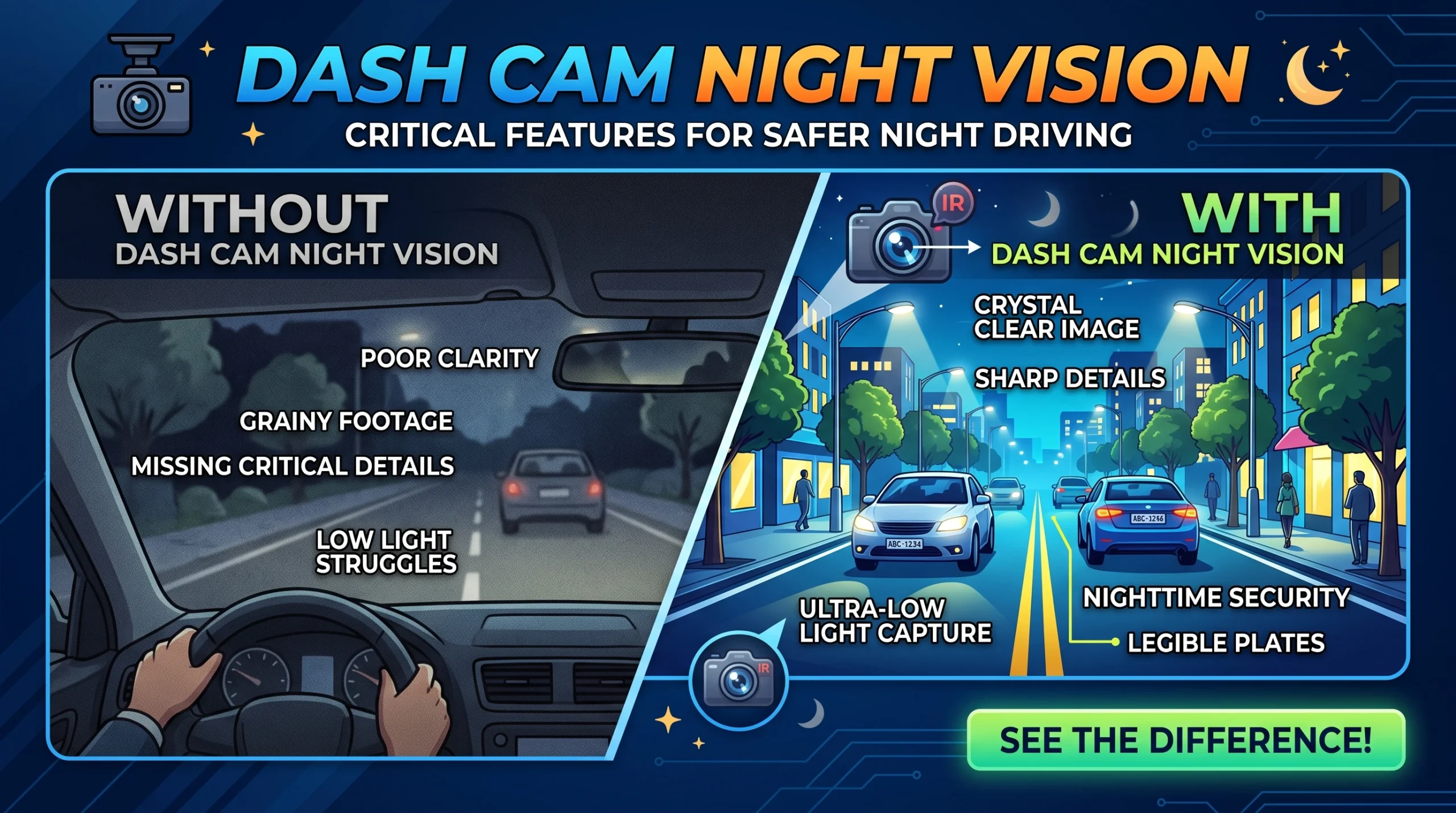
Three kinds of claim appear on dash cam listings, and they are not equally informative. A named sensor family such as Sony's STARVIS tells you something about the hardware. HDR or WDR tells you something about technique, though the two terms are used loosely enough to be worth checking. "Superb night vision" and "super night mode" tell you nothing at all. Learning which is which is most of what you need to compare two listings honestly.
Dash cams do not have night vision
Worth clearing up first, because the phrase is used constantly and means something specific elsewhere.
Night vision in the security-camera sense usually means infrared illumination: the camera emits infrared light and records the reflection, producing that familiar monochrome image. A road-facing dash cam cannot do this. Infrared illuminators cannot usefully light a road ahead, and they would reflect straight back off the windshield in front of the lens.
So a road-facing dash cam sees at night the same way your eyes do: by whatever light is actually there, which is headlights, streetlights and other traffic. "Night vision" on such a listing means low-light sensitivity, not infrared. The exception is a cabin-facing camera, where infrared illumination genuinely is used and genuinely works, because the subject is a meter away inside the car.
STARVIS: what the name actually tells you
STARVIS is Sony's brand for a family of image sensors marketed for low-light performance. When a listing names it, that is one of the few hardware facts in the whole description, and it is a reasonable positive signal.
What it does not tell you is which sensor from that family, which generation, or what the camera does with the data afterwards. Sensor families span a wide range of parts, and two cameras naming the same family can perform very differently depending on which specific sensor they use, what lens sits in front of it and how the processing handles noise and exposure. Sensor families and their marketing names also turn over, so a term that signalled the current top tier a couple of years ago may now signal the middle of the range.
Treat a named sensor family as evidence that the maker cared about the sensor, not as a performance guarantee. It is still better than the alternative, which is a listing that names no sensor at all.
HDR and WDR: one idea, two implementations, one shared word
Both terms address the same real problem: a night road contains bright headlights and dark shadows in one frame, and a single exposure cannot hold both.
HDR, high dynamic range, in its usual implementation captures more than one exposure and combines them, keeping detail in the bright parts and the dark parts of the same frame.
WDR, wide dynamic range, generally refers to processing that adjusts different regions of a single image rather than combining multiple captures.
In this market the two words are used interchangeably and often loosely, so the label alone does not tell you which technique a camera uses. What matters is that some form of dynamic range handling is present, because a camera without it will either blow out headlights and number plates or lose everything in shadow. This is also why dynamic range matters more than resolution for the specific job of reading a plate at night, a point we make in do you actually need 4K.
The claims that carry no information
- "Night vision" and "super night mode." Marketing labels for low-light behavior, with no defined meaning and no way to compare across brands.
- "Ultra clear night footage." A promise, not a specification.
- "Professional grade" or "cinema quality." Neither term means anything in this category.
- A large aperture number with no context. A wider aperture helps in low light, but on its own it says nothing about sensor size, noise handling or lens quality.
- Sample footage in the listing. Almost always chosen and often processed. Independent footage on video sites, filmed by owners in ordinary conditions, is far more informative.
What to look for instead
- A named sensor, ideally with the family and the specific part identified. A maker who publishes this is telling you something checkable.
- A stated dynamic range technology, in whichever wording, rather than silence on the subject.
- A moderate field of view. Spreading the same sensor across less scene is one of the cheapest ways to improve detail, at night as much as in daylight. See why wider is not better.
- Owner-filmed night footage of a road that looks like your roads, in weather that looks like your weather.
- Consistency rather than peak quality. A camera that produces reliably decent footage across conditions is worth more than one that produces excellent footage under conditions you rarely drive in.
The broader skill of reading these listings without being led is the subject of how to read a dash cam spec sheet, and where night performance sits among the other buying decisions is in the dash cam buying guide.
FAQ
What is STARVIS on a dash cam?
It is Sony's brand name for a family of image sensors marketed for low-light performance. Its presence in a listing is a positive signal about the hardware, but it does not identify which sensor from that family, and processing and lens still decide the result.
Is HDR or WDR better on a dash cam?
They describe different approaches to the same problem, and the terms are used loosely enough in this market that the label alone rarely tells you which technique a camera uses. Having some dynamic range handling matters far more than which word is printed.
Do dash cams have infrared night vision?
Road-facing cameras do not, because infrared illumination cannot usefully light a road and would reflect off the windshield. Cabin-facing cameras do use infrared, and there it works well because the subject is close.
Why is my dash cam footage poor at night?
Usually a combination of sensor limitations, no effective dynamic range handling, and a wide field of view spreading detail thin. A dirty or reflective windshield and dashboard glare also do more damage than people expect.
Does higher resolution improve night footage?
Not reliably. Smaller pixels on a higher-resolution sensor can gather less light individually, so a lower-resolution sensor with larger pixels sometimes performs better after dark. Sensor and processing decide night quality more than pixel count.
AutoGearZone does not sell dash cams and earns no commission from any brand or model named here. More on how we work on our about page.