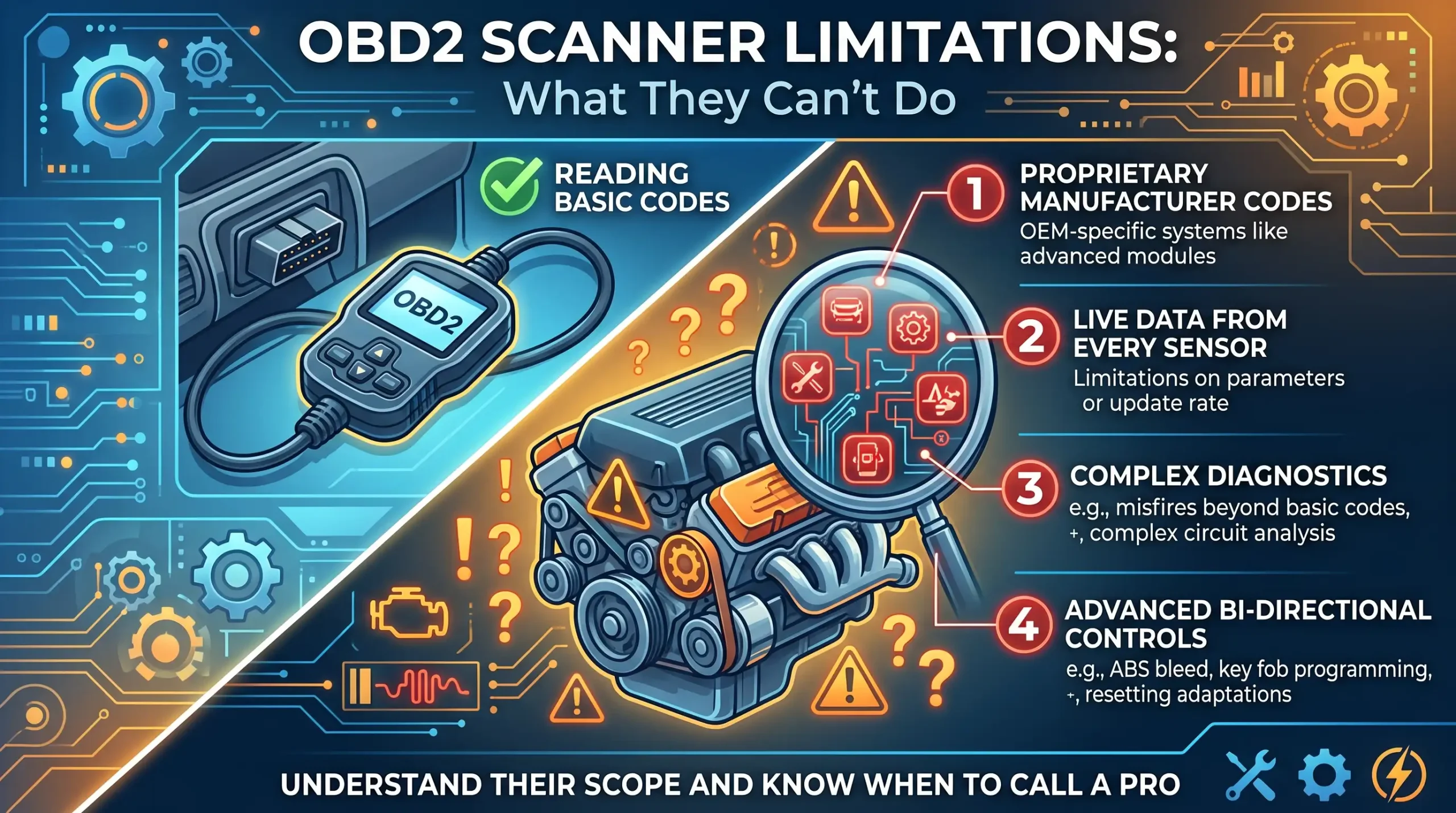
A scanner tells you what the car noticed and where it noticed it. It does not tell you what is broken. A fault code names a circuit, a signal or a monitored condition that fell outside expectations; the actual cause might be the component in that circuit, or the wiring to it, or a connector, or something entirely upstream that made a healthy sensor report an honest reading the car did not like. Reading the code is the beginning of the work, not the end of it, and this is the page where we say so.
A code names a circuit, not a broken part
This is the single most expensive misunderstanding in home car ownership, and it is easy to fall into because code descriptions are written in a way that sounds like verdicts.
A description mentioning a particular sensor does not mean that sensor has failed. It means the car's expectations for that signal were not met. That can happen because the sensor is bad. It can equally happen because the wiring is damaged, because a connector is corroded, because the sensor is reporting accurately about a genuine condition elsewhere, or because a related system is misbehaving in a way that shows up here first.
The pattern people fall into is: read code, buy the part named in the code, fit it, discover the fault is unchanged, repeat. That is not a failure of the tool. It is a category error about what the tool said.
Five things a scanner structurally cannot see
Anything outside its access. Generic OBD2 covers emissions-related powertrain data. Brakes, restraints, body systems and much else sit outside it, and "no codes found" from a basic reader is not an all-clear. That is set out in why cheap readers cannot see ABS, SRS and transmission codes.
Mechanical condition. Compression, timing wear, bearing noise, a leaking gasket, a seized caliper. A scanner reads what modules report. It has no opinion on the state of metal.
Anything the car does not measure. Modern vehicles are heavily instrumented but not completely instrumented. Plenty of failures produce no code at all because nothing is watching that particular thing.
Intermittent conditions it was not present for. If the fault did not occur while you were connected, live data has nothing to show you. The freeze frame attached to a stored code is often the only record of the event, which is why it is worth reading before you clear anything, as covered in freeze frame data.
Cause and effect. When several codes are stored, a scanner lists them. It does not tell you which one is the origin and which are consequences, and that ordering is frequently the entire diagnosis.
Why free code reads lead people wrong
A free code read at a parts counter is a genuine service and worth using. The failure mode is what happens next, and it is structural rather than dishonest: the person reading the code is standing in front of a wall of parts, and the natural output of the interaction is a part.
What is usually missing is the second half of the process. Nobody has looked at the freeze frame, nobody has checked whether other codes are present and in what order they set, nobody has verified the circuit before condemning the component, and nobody has asked what the car was doing when it happened. Those steps are the difference between a diagnosis and a guess with a receipt attached.
Owning your own tool helps here, but only because it lets you gather more before deciding, not because it makes the decision for you. Reading live data, covered in the ten PIDs worth watching, and commanding components to test them, covered in who actually needs a bi-directional scan tool, are both ways of gathering more evidence. Neither is a substitute for knowing what to do with it.
What the tool is genuinely excellent at
We are not talking anyone out of owning a scanner, and it would be strange for a site like this to try. What a scanner is very good at:
- Telling you whether a warning is emissions-related and whether the car has stored anything at all. That alone reframes a worrying dashboard light into a defined question.
- Giving you the vocabulary to have a useful conversation with a mechanic, and the ability to tell whether the answer you get relates to what the car actually reported.
- Confirming a repair. Clear, drive, see whether it returns. Without a tool you are relying on the absence of a light, which is a slower and less certain signal.
- Checking readiness before an emissions test, which is a small, concrete, money-saving use of a cheap tool.
- Watching a known condition over time, which is where live data logging genuinely earns its place.
If you are new to all of it, the first plug-in walkthrough is the place to start, and everything in this cluster builds from there.
Where to take the question next
If your question has become "what is wrong with my car" rather than "what is this tool showing me," you have crossed a line this site deliberately does not cross. We write about the gear: which tool, how to operate it, what its outputs are as outputs. We do not diagnose vehicles, and we would rather say so than write something plausible and wrong about your car.
Within our own network, warning lights, symptom triage and what a code implies about a fault belong to autoartificer.com rather than to us. We mention that in words rather than sending you there with a link, because cross-site linking is not something we do without a good reason. For anything with a safety dimension, and for anything you would be acting on, the right next step is a qualified mechanic. Our disclaimer applies to everything here and to this page in particular.
FAQ
Does an OBD2 code tell me which part to replace?
No. It names a circuit or a monitored condition that fell outside expectations. The named component is one possible cause among several, alongside wiring, connectors and upstream conditions.
Why did replacing the part in the code not fix my car?
Because the code described where the car noticed a problem, not what had failed. This is the most common and most expensive misreading of a scan result, and it is a category error rather than a fault with the tool.
Can a scanner find a problem if there is no warning light?
Sometimes. Pending codes and live data can reveal conditions before a light appears. But plenty of faults produce no code at all, because not everything on a car is monitored.
Is a more expensive scanner better at telling me what is wrong?
It shows you more, across more systems, which is genuinely useful. It does not interpret for you. More capability produces more data, and data still has to be read by someone who knows what they are looking at.
Should I still buy an OBD2 scanner?
For most owners, yes. Knowing whether the car has stored anything, reading the conditions it happened under, checking readiness before a test and confirming a repair are all worth the modest cost. Just buy it as an information tool rather than as an answer machine.
AutoGearZone does not sell scanners and earns no commission from any brand or tool named here. More on how we work on our about page.