
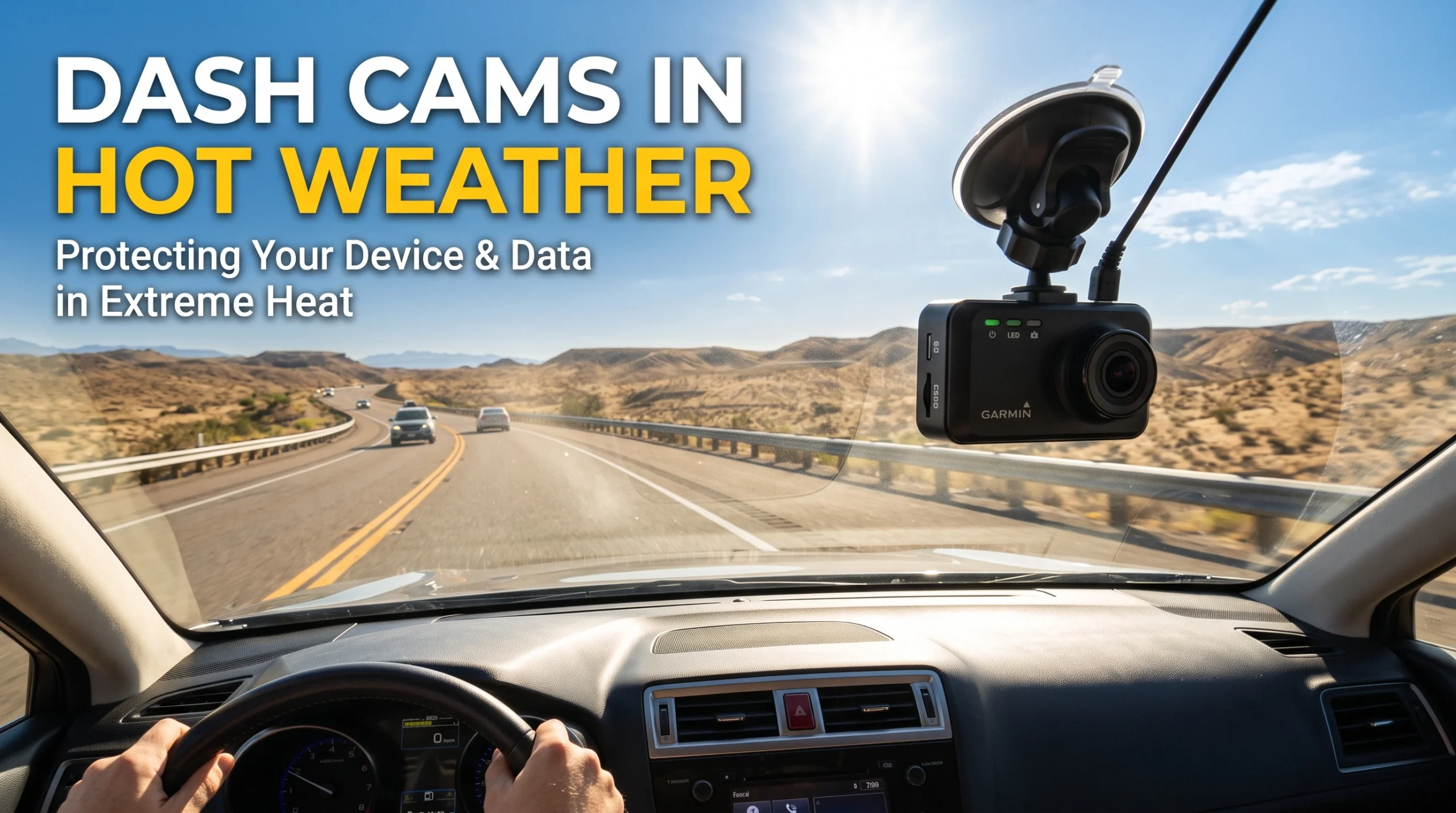
A dash cam lives on a windshield, behind glass, in a sealed metal box parked in the sun. That is one of the hotter environments any consumer electronic device routinely occupies, and it is harder on a camera than winter is, because heat damage accumulates permanently while cold problems usually resolve when things warm up. If you park outside in a hot climate, buy a supercapacitor camera, check the published upper operating limit rather than the storage limit, and expect the mount and the memory card to give you trouble before the camera does.
What this page is. It compares published specifications and documented behavior of these component types. We have not baked a shelf of cameras through a desert summer and measured what survived, and we are not going to imply we have. The operating range printed on the model you are considering is the figure that governs your purchase.
Why heat is the worse of the two extremes
Cold and heat are not symmetrical, and most buyers rank them the wrong way round.
In cold, a lithium cell loses usable capacity and a display gets sluggish. Both recover. The camera that would not start at seven in the morning generally works fine by lunchtime, and nothing has been permanently lost except the footage you did not get.
In sustained heat, the degradation reactions inside a lithium cell run faster and the damage does not reverse. Capacity that is gone stays gone, and in the worst case the cell swells. Semiconductors also do not enjoy sustained high temperature, and adhesives soften. Every hot afternoon spends a little of the camera's remaining life, and the total is cumulative over seasons.
Interior temperatures in a parked car in direct sun are widely reported to reach levels well above the outside air temperature, which is why this is a real consideration rather than a theoretical one. We are not going to put our own number on it, because the honest answer depends on the car, the glass, the color, the ventilation and the sun angle, and a single figure would be a false precision.
What actually fails first in a hot car
The mount, and it is not close. Adhesive pads soften with heat and lose grip, and the classic summer failure is coming back to a car with the camera hanging by its cable or lying in the footwell. This happens to cameras that are otherwise perfectly healthy, and it is the most common heat complaint by a wide margin.
The memory card. Cards have their own operating ranges, and continuous writing generates heat of its own on top of what the cabin supplies. A card working at its limits in summer fails sooner, and it fails in the way cards fail: quietly, with corrupted files you do not discover until you need one.
The lithium cell, if the camera has one. Sustained heat is what ages it. If a camera's casing distorts, if it no longer sits flat, or if the unit becomes noticeably swollen, stop using it, do not puncture or compress it, and dispose of it according to your local rules for lithium batteries.
The camera itself, last. Thermal shutdown, where the unit stops recording until it cools, is a protective behavior rather than a fault, and a camera that does it is looking after itself. It is still a camera that was not recording, which is the point.
What to look for when buying for heat
- Supercapacitor power, for the same reason as in the cold but with more at stake, since heat damage to a lithium cell is permanent. The full comparison is in supercapacitor versus lithium battery dash cams.
- A published operating temperature range, upper end specifically. Many listings quote a wider storage range and let you assume it is the operating range. Those are different claims, and the difference is exactly the one that matters here. We go through this and the other spec-sheet traps in how to read a dash cam spec sheet.
- A high-endurance memory card with its own stated temperature range. Buy it at the same time as the camera, not later.
- A design that is not a sealed black slab in full sun. Ventilation, casing material and color all make a difference, and a camera tucked behind the mirror is in shade for part of the day.
- Automatic thermal protection. A camera that shuts down before it damages itself is behaving correctly. A camera with no such behavior is trusting the environment.
Where this sits among the other buying decisions is set out in the dash cam buying guide, and the opposite extreme, which shares more with this than you would expect, is in what survives a real winter.
What helps that is not a purchase
- Park in shade where you can. Unglamorous, and by far the most effective thing available.
- Position the camera behind the rear-view mirror. It sees better from there anyway, and it spends part of the day in the mirror's shadow.
- Take it down for long summer parking. If the car is going to sit at an airport for two weeks in July, removing the camera costs a minute and removes the worst exposure it will get all year.
- Prepare the mount for heat. Clean glass, a properly cured adhesive bond and a cable routed so it is not pulling on the mount all make the summer failure less likely.
- Replace the card on a schedule rather than on failure. Cards are consumables and a hot climate shortens their life. Replacing one preemptively is cheaper than discovering it failed on the day something happened.
Products exist for managing cabin heat generally, from shades to powered ventilation. They are a legitimate answer to the underlying problem and they are not our subject; this site covers the gear on the windshield rather than the climate of the cabin.
FAQ
Can a dash cam overheat in a parked car?
Yes. Many cameras shut down protectively at high temperature, which stops the recording but prevents damage. A camera without that protection is relying on the environment staying within limits.
Is heat worse for a dash cam than cold?
Generally yes, because heat damage accumulates permanently while cold problems usually reverse when the device warms up. Cold costs you a morning; heat costs you life.
Why does my dash cam keep falling off the windshield in summer?
Adhesive softens with heat and loses grip. Clean glass, a properly cured bond and a cable routed so it does not tug on the mount all help, as does positioning the camera where it gets some shade.
Do supercapacitor dash cams handle heat better?
Yes, meaningfully. Supercapacitors are commonly specified for a higher upper operating limit than lithium cells and do not have the swelling failure mode. Other components still set their own limits.
Should I remove my dash cam in summer?
For long periods parked in direct sun, taking it down is a reasonable precaution and costs a minute. For daily use it is unnecessary, and shade plus a sensible mounting position does most of the work.
AutoGearZone does not sell dash cams and earns no commission from any brand or model named here. More on how we work on our about page.