
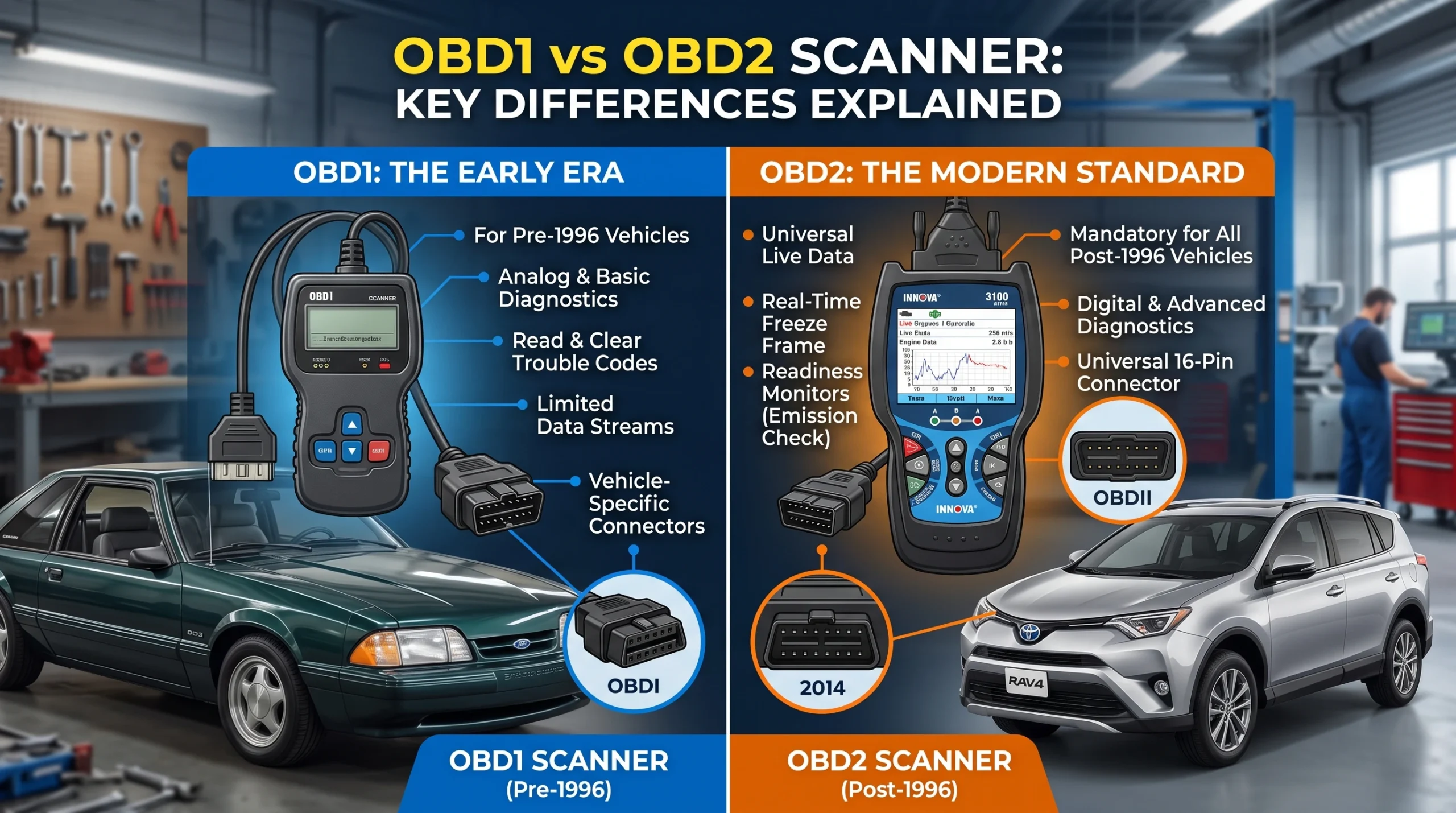
If your car predates OBD2, no OBD2 scanner will help you, and no adapter turns one into an OBD1 tool. The reason is not that the older cars are primitive. It is that OBD1 was never a single standard: each manufacturer implemented its own connector, its own protocol and its own code list, so a universal OBD1 scanner could not exist even in principle. What exists instead are three routes, and which one applies depends on who built your car.
Why there is no universal OBD1 scanner
OBD2 works because it was mandated. A regulator specified the connector, its location, the protocols and a common data set, and every manufacturer selling into that market complied. That is why a tool bought anywhere works on a compliant car built anywhere.
Before that, on-board diagnostics existed but nobody had told the manufacturers to agree. Each developed its own approach, and the differences went all the way down: different connectors, in different places, using different signalling, reporting different codes with different meanings. Two cars from the same year could have nothing diagnostically in common.
So the question "which OBD1 scanner should I buy" has no general answer. The answerable question is "what did my manufacturer do," and that is a per-brand research task rather than a shopping one. This is the same manufacturer-specific territory that still exists today outside the standard, described in scanner brand coverage; the difference is that on a pre-OBD2 car, that territory is the whole car.
The cut-off, and how to check where your car sits
In the United States, OBD2 was required on cars and light trucks from the 1996 model year. In Europe the change came later and in stages, with petrol vehicles brought in before diesels, and other markets adopted equivalents on their own timetables. So the year that matters depends on where the car was originally sold, not only on when it was built.
Model years are also not calendar years, and vehicles built around a transition can go either way. The practical checks are physical rather than documentary: a standardized sixteen-pin connector in the standardized area under the dash is the strongest sign, and a compliance label under the bonnet stating that the vehicle conforms to OBD2 is stronger still. Our port location guide covers where to look, and what OBD2 compliant means for your model year goes through the checks in order.
If you find a rectangular sixteen-pin connector, plug a scanner in. That is a faster answer than any amount of research, and a connection that establishes settles it.
The three routes for a pre-OBD2 car
A manufacturer-specific tool or adapter. For most of the major makes of that era, someone still sells an interface and software for that brand's system, often aimed at enthusiasts of specific models. This is usually the best route if you intend to keep the car. Ask in a community for your specific model rather than searching for OBD1 generally, because the useful answers live there.
The car's own built-in code output. Many pre-OBD2 vehicles can report their stored codes without any tool at all, typically by flashing them out on a dashboard lamp after a specific procedure. The procedure differs by manufacturer and sometimes by model, and doing it wrong can mean anything from a wasted afternoon to shorting something you did not intend to. We are deliberately not printing a procedure here, because a generic one would be wrong for most readers and this is exactly the case where the vehicle's own factory service documentation is the only source worth following.
A specialist. An independent workshop that works on cars of that era usually has the interfaces and, more valuably, the experience. For a one-off fault this is frequently cheaper than assembling a toolkit for a system you will use once.
What you gain by not having OBD2
Worth saying, because the tone of most writing on this subject is apologetic and it does not need to be.
A pre-OBD2 car has far fewer modules, far less network complexity and far more that can be assessed directly with a multimeter, a test light and your senses. There is no security access to negotiate, no module to brick, and no subscription to keep current. Much of what a scan tool exists to reveal on a modern car is simply visible on an older one.
What you lose is the convenience of a standard part number for the answer. What you keep is a car that can be understood without one, which is a fair trade and one plenty of owners make deliberately.
If you also run a newer car and are buying a tool for that one, none of this changes the ordinary criteria, and the first plug-in walkthrough is the place to start.
FAQ
Will an OBD2 scanner work on a pre-1996 car?
No. The connector, the protocols and the code definitions are all different, and there is no standardized data for the tool to request. An adapter that makes the plug fit does not make the systems compatible.
What year did OBD2 become mandatory?
In the United States it was required for cars and light trucks from the 1996 model year. Europe phased it in later, with petrol vehicles ahead of diesels, and other markets set their own dates. Where the car was originally sold matters as much as when it was built.
Is there a universal OBD1 scanner?
No, and there could not be. OBD1 was implemented separately by each manufacturer, with different connectors and protocols, so tools for it are brand-specific by necessity.
Can I read codes on an old car without a scanner?
Many pre-OBD2 vehicles can flash their stored codes on a dashboard lamp after a manufacturer-specific procedure. The procedure varies by make and model, and the vehicle's factory service documentation is the source to follow rather than a general guide.
How do I tell whether my car is OBD1 or OBD2?
Look for a standardized sixteen-pin connector in the usual area under the dash, and for an under-bonnet label stating OBD2 compliance. If a scanner connects and returns data, that settles it.
AutoGearZone does not sell scanners and earns no commission from any brand or tool named here. More on how we work on our about page.