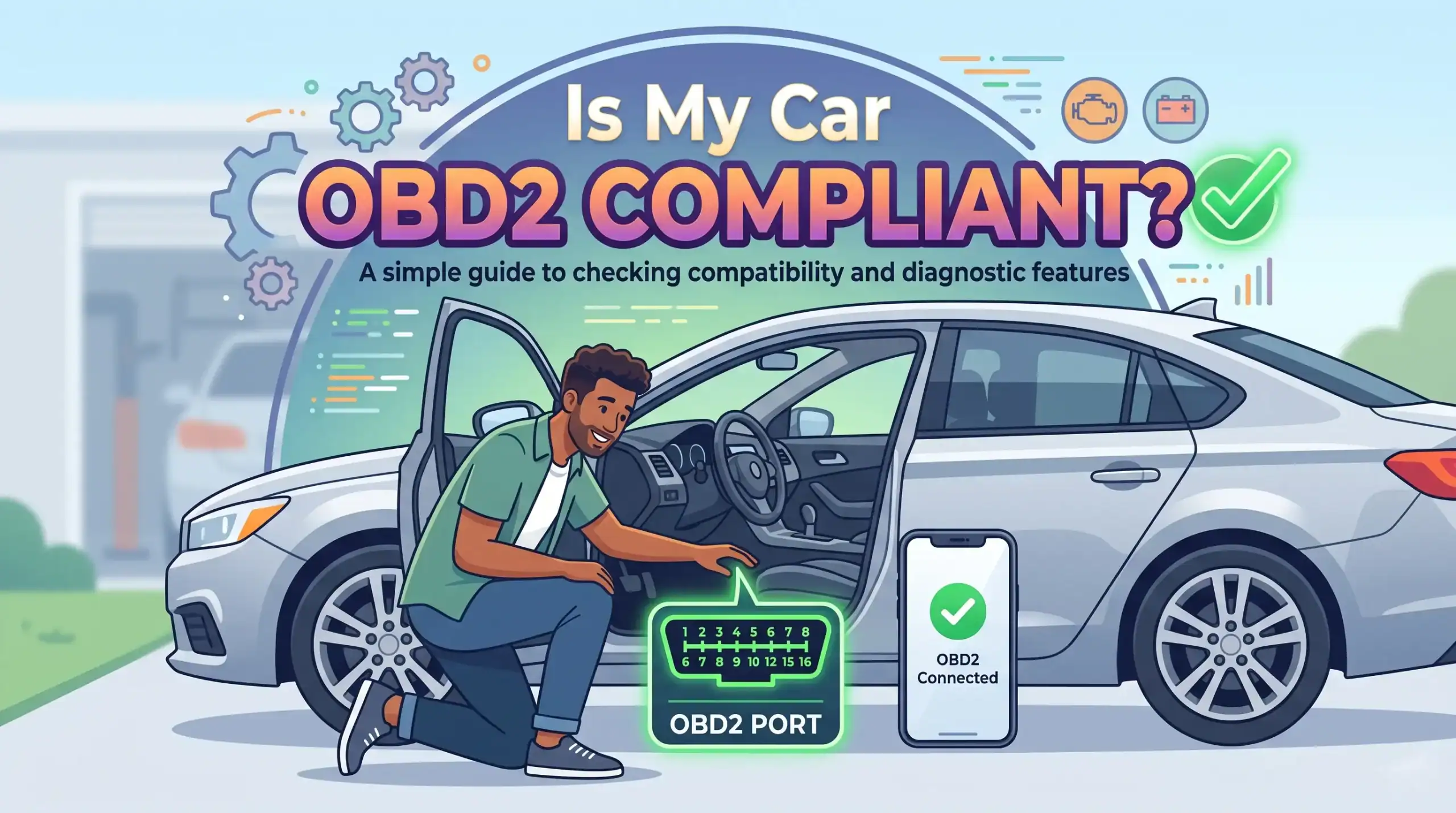
In the US, every gasoline car and light truck built for model year 1996 or later is required to be OBD2 compliant. Diesel vehicles came under the full federal requirement later, around model year 2007. In the EU, the equivalent mandate generally applies to gasoline vehicles from around 2001, with diesel vehicles following a few years after. "Compliant" means the car has a standardized 16-pin port and speaks at least one of the recognized OBD2 communication protocols, which is what lets a generic scanner read it at all. If your vehicle predates these cutoffs, a modern OBD2 scanner likely will not work on it.
Why "how old is my car" is the wrong question
The natural instinct is to check your car's age, but the honest answer depends on three things at once: the country it was built for, the model year (not the calendar year you bought it), and the fuel type. A 1997 US-market gasoline sedan is compliant. A diesel truck from the same model year, sold in the same country, may not be, because diesel vehicles were brought under the full federal mandate later than gasoline ones. Model year, not purchase date or manufacture date, is what regulations actually key off, and model year can run ahead of the calendar (a "2027" model year car can be built and sold in 2026).
The compliance cutoffs, plainly stated
| Region | Fuel type | Generally compliant from |
|---|---|---|
| United States | Gasoline | Model year 1996 |
| United States | Diesel | Full federal requirement around model year 2007 |
| European Union | Gasoline | Generally around 2001 |
| European Union | Diesel | A few years after gasoline, varying by market |
These are the broad regulatory cutoffs, not a guarantee for every specific model or import. A vehicle imported from a market with different rules, or a low-volume or specialty model, can sit outside the general pattern. When precision matters (buying a scanner, confirming a code-reading capability before a trip), verify with your owner's manual or manufacturer documentation rather than relying on the model-year rule alone.
What "compliant" technically requires
A vehicle is not OBD2 compliant just because it has some kind of diagnostic connector. Compliance specifically means:
- A standardized 16-pin Data Link Connector, in a location within reach of the driver's seat, covered in our OBD2 port location guide.
- Support for at least one recognized communication protocol, so a generic scanner can actually establish a connection and pull data, not just plug in physically.
- Standardized diagnostic trouble codes for emissions-relevant systems, the P0xxx-style codes that mean the same thing across every compliant make, explained in our guide to using an OBD2 scanner.
A car built before these requirements may still have some onboard diagnostic system, often called OBD1, but it is proprietary to that manufacturer and usually needs a brand-specific tool, not a standard OBD2 scanner.
How to actually check your specific car
The regulatory cutoffs above are a strong general rule, but the fastest way to confirm your specific vehicle is to check directly rather than rely only on the year:
- Look for the port itself. A standardized 16-pin trapezoidal connector near the steering column is the clearest physical sign. See the port location guide for where to look.
- Check your owner's manual. Manufacturers state OBD2 compliance directly for borderline model years, especially the first year or two after a mandate took effect in a given market.
- Try a scan. If you already own or can borrow a basic scanner, plugging in and attempting a connection is the most direct confirmation available.
Imports, gray-market cars, and other edge cases
The model-year table above describes the general regulatory pattern for vehicles built for the US and EU markets. It does not automatically cover every car on the road:
- Gray-market and privately imported vehicles were often built to a different market's specification, which may or may not include OBD2 at all, regardless of the model year. A vehicle built for a market without an OBD2 mandate at the time will not gain compliance just because it is later imported somewhere that requires it.
- Low-volume and specialty manufacturers sometimes received phase-in periods or exemptions that differ from mainstream production timelines. If you own something unusual, the manufacturer's own documentation is more reliable than the general rule.
- Federal versus state or regional requirements can occasionally diverge in the transition years right around a mandate's start date. The clearest sign you are in one of these edge cases is a car built within a year or two of a cutoff date; that is exactly when it is worth checking directly instead of assuming.
Why this matters before you buy a scanner
Buying a scanner for a car that predates OBD2 compliance in your market is the single most common reason a new scanner "does not work." The tool is not defective; it is designed for a standard your vehicle does not use. This becomes even more relevant on the newest end of the range too: some recent vehicles have moved to faster underlying protocols that an older scanner may not fully support, which is a different but related compatibility question covered in our guide to CAN FD and DoIP.
FAQ
What year did OBD2 become mandatory in the US?
Model year 1996 for gasoline cars and light trucks. Diesel vehicles came under the full federal OBD2 requirement later, around model year 2007.
Is my car OBD2 compliant if it's from Europe?
Generally, EU gasoline vehicles became compliant from around 2001, with diesel vehicles following a few years later depending on the specific market and regulation. Check your owner's manual for a definitive answer on a borderline model year.
Does having an OBD port mean my car is fully OBD2 compliant?
Not necessarily. Some vehicles have a similarly shaped connector used for a different, non-standardized diagnostic system. True OBD2 compliance means the port supports at least one recognized OBD2 communication protocol, which is what actually lets a generic scanner read the car.
What happens if I plug a scanner into a non-compliant car?
Typically nothing harmful happens; the scanner simply fails to establish a connection or shows no data. It is not dangerous, just non-functional, because the car is not speaking a protocol the tool expects.
Can an older, non-OBD2 car be scanned at all?
Often yes, but not with a standard OBD2 tool. Pre-compliance vehicles typically use a manufacturer-specific OBD1 system that needs a brand-specific reader rather than a generic scanner.
AutoGearZone does not sell diagnostic tools and earns no commission on anything named here; this guide exists to help you confirm compatibility before you spend money on a scanner that will not work. More on that approach on our about page.