
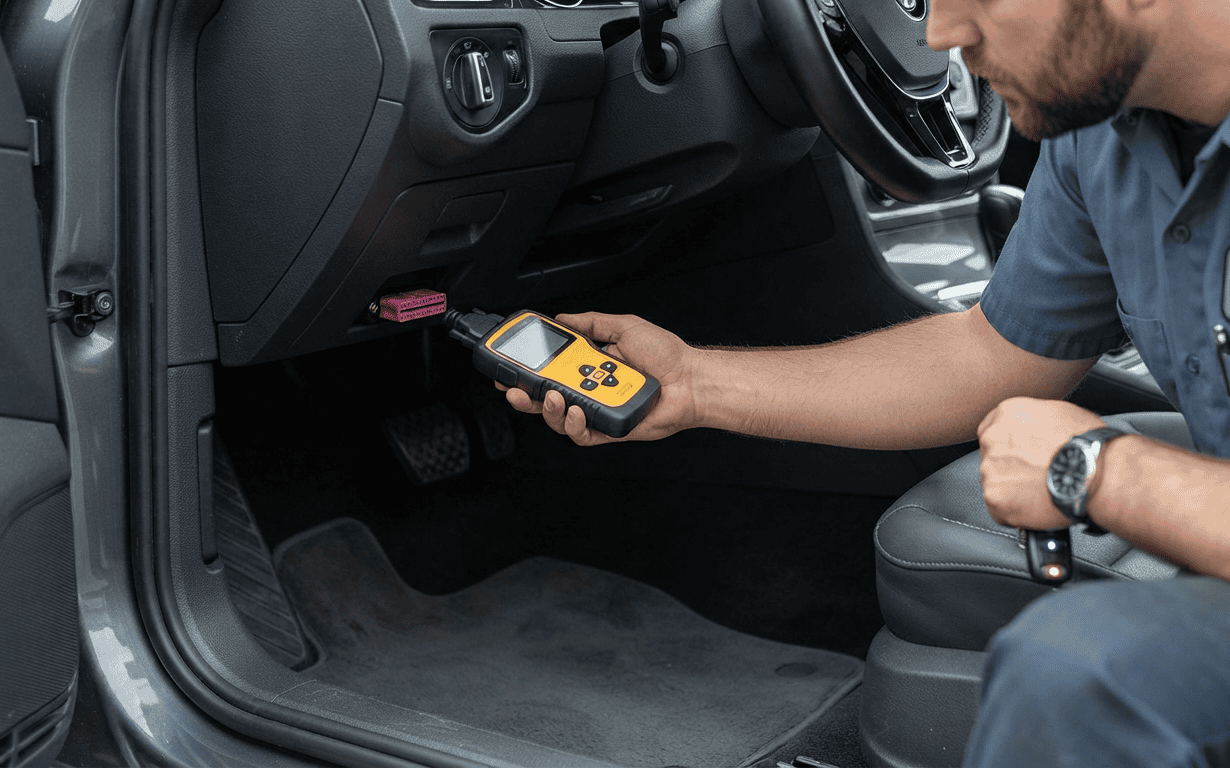
The OBD2 port is a 16-pin, trapezoid-shaped connector, and by federal design it has to sit within about two feet of the steering wheel. On the large majority of cars, that means under the driver's-side dash, just above and to the left of the pedals, sometimes hidden behind a small plastic flap. If it is not immediately visible, run your hand along the underside of the dash rather than searching by eye. A handful of makes tuck it somewhere less obvious, and those are covered below.
If you already know where your port is and just need to plug something in, jump to how to use an OBD2 scanner once you have found it. If you cannot find it after checking the spots below, the manual is faster than guessing.
Why the port is always roughly in the same place
This is not manufacturer courtesy. US and EU regulations that created the OBD2 standard also specify where the connector has to physically live: within reach of the driver's seat, without tools, so a technician (or you) can plug a scanner in without removing trim or crawling under the car. That rule is why the port's location barely varies across brands, even though everything else about a dashboard does.
The connector itself is a standardized 16-pin trapezoid, usually black or gray plastic, roughly the size of a matchbook. Some cars color-match the cover to the interior trim, which is the main reason people miss it while looking for something that stands out.
Check these spots, in order
Most drivers find the port in the first two places on this list.
- Directly below the steering column, often just above the brake pedal. This is the single most common location across nearly every mainstream US, Japanese, and Korean make.
- Behind a small hinged panel or flap near the same spot, styled to blend into the dash trim. Push gently on the edges; most pop open by hand.
- Behind or beside a removable ashtray or coin tray on older center-console designs.
- Low on the center stack, near the base of the dashboard, on some European models where the column area is more crowded with wiring.
- Just above the parking-brake pedal or floor vents, occasionally seen on trucks and SUVs with a wider transmission tunnel.
If none of those turn it up, your owner's manual will show the exact location for your specific trim, and it is the fastest route once the obvious spots have failed.
Makes and layouts where the port hides a little more
A few patterns are common enough to call out on their own.
- Some German models route the connector lower on the center stack rather than under the column, which is part of why BMW-specific scanner coverage is its own conversation: full-system access matters more once you are past a generic reader.
- Trucks and larger SUVs sometimes place it further right, closer to the center console, because the steering column area is shared with more mechanical linkage.
- Cars with a factory-installed telematics or fleet-tracking dongle may already have something plugged into the port. If a device is already there, you will need to unplug it (or use a splitter) rather than assume the car has no port.
What the connector looks like once you find it
It is worth knowing the shape so you recognize it instantly rather than mistaking it for another connector nearby. The OBD2 port is a female, trapezoidal 16-pin socket, wider on one side than the other so a scanner cable can only be inserted one way. It is not the same shape as a USB port, an aux jack, or a 12V accessory socket, and none of those will accept an OBD2 cable.
If the port looks damaged, loose, or modified
Occasionally the port itself is the problem rather than its location. A few things worth ruling out before you assume a scanner is faulty:
- Bent or missing pins. Sixteen small pins sit inside the socket, and a previous rough connection can bend one. A bent pin usually means an intermittent connection rather than no connection at all, which can look like a flaky scanner when the port is actually at fault.
- A loose or cracked mounting bracket. The port is normally screwed or clipped to a bracket behind the dash. If it wiggles significantly when you plug something in, the bracket rather than the connector itself has likely failed.
- Corrosion from a spill or long-term moisture. This is uncommon but not rare on older vehicles, and it presents as an unreliable connection that comes and goes as the cable moves.
- A relocated port from a prior repair. On some vehicles that have had significant dash work, a shop may have extended or relocated the connector with a pigtail. If your port sits somewhere none of the patterns above describe, this is worth asking about if you know the car's repair history.
None of these are common, and for most drivers the "I can't find it" problem in this guide is simply a matter of not knowing which flap to open. But if you have found a port and it still will not hold a reliable connection, the port itself, not your scanner, is the more likely explanation.
If your car does not have one at all
Every gasoline car and light truck sold in the US since 1996, and most gasoline models in the EU since roughly 2001, is required to carry a standard OBD2 port. Diesel vehicles came under the same US federal requirement later, around model year 2007. If your vehicle predates those years, it likely does not have a standard OBD2 connector at all, and any diagnostic tool for it will need to be OBD1-specific rather than a modern scanner. See our note on what an OBD2 scanner cannot do for older cars for the boundary between the two standards.
FAQ
Is the OBD2 port always under the steering wheel?
Almost always, but not universally. Regulations require it within about two feet of the steering wheel, which usually puts it under the dash on the driver's side. A minority of models, mostly European, route it lower on the center stack instead.
Why can't I find my OBD2 port even though my car is new enough?
The most common reason is a trim panel or flap covering it. Run a hand along the underside of the dash near the column rather than relying on sight alone, since the cover is often color-matched to blend in.
Does every car since 1996 have an OBD2 port?
Every gasoline car and light truck sold in the US from model year 1996 onward is required to have one, and gasoline models in the EU generally from around 2001. Diesel vehicles came under full federal OBD2 requirements later, around 2007 in the US. Older vehicles may have an OBD1 connector instead, which a standard OBD2 scanner cannot read.
Can something already be plugged into my OBD2 port?
Yes. Fleet-tracking devices, some insurance telematics boxes, and aftermarket remote-start modules commonly occupy the port permanently. If you find a device already there, you will need a splitter or to temporarily unplug it to use your own scanner.
What does the port look like if I'm not sure I've found it?
A trapezoid-shaped, 16-pin female socket, wider at the top than the bottom, usually black or gray plastic. It only accepts an OBD2 cable in one orientation, so if a connector seems to force or not fit, you likely have the wrong port.
AutoGearZone does not sell diagnostic tools or earn a commission on anything named on this site; the goal here is a location guide that gets you to the port faster than searching by eye. More on that approach on our about page.